We’re taking a brief break from historical murders this week so I can fangirl over my new favourite novel in another installment of: The Book I’m Currently Obsessed With. (You can read the previous installment here.)
I know you’re dying to know what it is and I’m dying to tell you, so let’s get right to it.
A Song Below Water by Bethany C. Morrow
This book hits all my sweet spots, in terms of genre, subject, writing, characters, everything.
First, let’s start with setting. I love contemporary settings with fantastical elements. This book is set in modern day Portland, but in a universe where mythical creatures are real. Gargoyles exist. Sprites, mermaids, sirens and elokos exist. Add to that the complexities of a society that is not only racist towards skin colour, but also towards mythical heritage and the book is already rife with tension from the get go.
Then we have our main characters; Tavia, who is a siren, and Effie, who is… well, she’s not sure exactly. They’re not blood related but they are sisters, having developed a beautiful and unbreakable bond when Effie came to live with Tavia and her parents.
It’s such a captivating story of how sisterhood and love can overcome, and how trust in the people we love can lead us through darkness. It’s also a gripping adventure with a slowly unwinding mystery and hints of romance, so believe me when I say it has it all.
And if you’re wondering if I went out in my garden and had a photo shoot with a book, the answer is yes. I like it that much, okay? So please, do yourself a favour and go out and get it. Because it’s great.
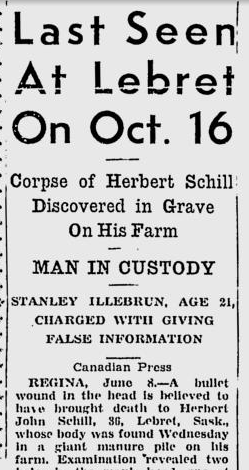
It was a routine Sunday for Herbert Schill on October 16, 1938 in Lebret, Saskatchewan. First church, then lunch with a friend before returning home to his farm where his wife and family waited. In the evening, he changed out of his church clothes and went out to the barn with their farmhand, Stanley Illerbrun, to milk the cows.
About an hour and a half later, Stanley returned to the house and asked Gertrude, Herbert’s wife, if she’d seen her husband. When she said no, obviously confused since they’d gone out to the barn together, Stanley explained that while they were milking the cows, a car had pulled into the yard and a man had come to the barn door and called to Herbert. The two men had gone off together and Herbert never returned to the barn to help finish the milking.
Gertrude was a little worried, but decided to wait. The next morning, when he still wasn’t home, she decided to contact the RCMP and report his disappearance.
It took two more days for the RCMP to come out to the farm. Stanley repeated his story and police dogs were brought in to help with the search. Police and neighbours gathered to check straw piles, granaries, buildings, old wells, bluffs and coulees throughout the valley. No trace of Herbert Schill was ever found.
Thinking it odd that the mysterious stranger would go to the barn without first stopping at the house, the RCMP questioned Stanley again, but he was resolute in his story. Could the man have arranged to meet with Herbert earlier? Did he know enough about Herbert to be so sure of his habits?
The search continued but soon winter came and the area was covered in a blanket of snow. In January, no longer needed as a farmhand, Stanley moved back to his father’s farm at his hometown of Gull Lake.
The people of Lebret never stopped wondering what happened to Herbert Schill and rumours abounded. Most suspected murder of some kind or another. The neighbours, unhappy with the Mounties’ conduct of the search, decided to dig up the ground around Schill’s farm as soon as they finished the spring seeding. The Mounties heard of the plan and sent a detachment of officers, headed by Detective Sergeant Hermanson, to supervise the search.
Under the direction of Hermanson, the group began to dig up the large manure pile behind the barn. They moved about three and a half feet of fresh manure when two neighbouring farmers hit something hard and brittle.
They knew that Schill had a colt that died and had maybe buried it in the manure pile, but as they turned over the pile, it was a farmer’s smock and something round like a skull with black hair the same colour as Schill’s that waited for them.
The Mounties stepped in, and using their hands and a small curry-comb, carefully uncovered the body, lying on its right side. He was still wearing overalls and boots and laying next to the skeleton was Schill’s hat, decayed but recognizable, his watch, its hands stopped at 9:15, and his spectacles, surprisingly unbroken.
An autopsy was performed and a bullet hole with no exit wound was found in the back, right hand side of the skull. There was also a hairline fracture on the right side of the skull most likely made by the course of the bullet, as well as a fracture on the left side of the skull, which the pathologist deemed likely the result of the force of impact from the bullet. Two pieces of lead were found in the brain.
It was at this point that the neighbour’s began to remember some odd behaviour on the part of Stanley Illerbrun. Herbert’s brother, Ed, recalled that whenever Stanley dumped manure on the pile, it was always on the spot where Herbert was buried. Two other farmers told officers that during the initial search, when they started poking around the manure pile, Stanley told them they were needed to help search the bluffs.
RCMP in Gull Lake immediately arrested Stanley for giving a false statement and Det. Sgt. Hermanson went straight down to collect him. When he spoke with the prisoner, Stanley confessed that they’d argued and he’d grabbed the rifle from the barn wall and shot him.
Apparently, Stanley was put out that he hadn’t received the two Sundays off each month that he’d been promised and Herbert was always trying to cut his wages. During the trial it came up that Herbert had also found Stanley in his twenty-one-year-old sister’s room and had forbade Stanley from ever going in there again, but it wasn’t mentioned in the confession.
Stanley was found guilty and sentenced to hang at his trial in October, 1939, but was granted a new trial after his defense argued that the judge had improperly instructed the jury.
At the second trial, in March of 1940, Stanley claimed that it was self defense, that Herbert had come after him and he’d run past the cows and gone through the three foot hole in the horse barn. He said he fired a shot with the rifle without looking, thinking it would make Herbert back off, over a cow’s back and after waiting a few minutes and hearing nothing, he’d come back and discovered Herbert was dead. He’d panicked and buried him in the manure.
But if that was the case, why not mention it in his initial confession?
The jury once again found him guilty and on June 21, 1940, he was hung.
Unfortunately for Stanley, his clever storytelling could only delay the inevitable discovery of Herbert Schill’s body, not prevent it. Hidden so close at hand, beneath the manure, he would have walked by it nearly every day. It must have been a shock for Gertrude to learn that his body had been there the whole time, and the farmhand she trusted to look after her children was behind it. And if Stanley was so very panicked as he claimed, it’s interesting to think of how he managed to hide the body, clean up any mess, come up with his story and finish the milking in only an hour and a half.
If only he’d been clever enough to just quit instead.
Information for this post was gathered from the book, THE PATHOLOGICAL CASEBOOK OF DR. FRANCES MCGILL by Myrna L. Petersen, as well as the following editions of the Saskatoon Star Phoenix: June 8, 1939, June 12, 1939, June 20, 1939, October 25, 1939, October 26, 1939, November 6, 1939, November 16, 1939, November 22, 1938, November 28, 1939, March 13, 1940, March 15, 1940, and March 16, 1940.
Thank you for reading! Please subscribe and share!
About a month ago we bought an outdoor rabbit hutch. Yes, I have a rabbit. I don’t mention him often because he’s not very interesting. Widget (that’s his name) is eight years old. Yeah, remember that when your kid asks for one. Also they shit their entire body weight daily and sometimes while using the litter box they miss entirely and mist the walls with pee. However, they are very soft, so there is that.
Anyway, over the past 3-4 years of his epically long life I’ve grown more and more allergic to him. Or his hay. Or both. I’m not sure which. But its gotten to the point where if I go into the office where he lives without a mask on I sound like I have pneumonia for the next two days. So we decided to try moving him outside.
Since getting the hutch, I’ve been bringing Widget outside for short periods of time to let him get used to it. It’s been going well, so this past Saturday I took him out in the morning with the intention of leaving him alone for the first time and letting him spend the whole day outside.
I hung out with him for a while, weeding in the garden while he ate his breakfast before I planned to go inside and take a shower.
That’s about when I looked up and saw the cat in our yard. Now, I’m familiar with this cat, he’s very friendly, in that he’ll meow at you, rub up against your legs, but if you pet him, he attacks. So, you know, a cat.
He hadn’t noticed Widget yet and Widget was still eating his breakfast, being chill so I was hoping the cat wouldn’t notice him, get bored and wander off.
No dice.
As I was chatting with the cat, casually trying to obscure his view of Widget, he caught sight of him. And when I say that cat went from lolling about in the grass to full murder mode, I am not kidding.
Widget’s no fool. He went straight into the little closed off room in his hutch (which is there for I imagine this exact reason), and the cat began looking for his way in. It was immediately obvious that murder kitty was not going to lose interest. He was going to figure out how to get those doors open and help himself to a plump, rabbity snack.
At this point, I was pressed up against the door to Widget’s panic room, waiting for the cat to lose interest long enough for me to scoop him out and take him inside. The cat was not impressed. Remember how I said he bites? Yeah.
He had jumped onto the roof of the hutch, and annoyed with my interference, started biting my shoulder.
Oh my God, so much fun.
I should probably mention I’m also allergic to cats.
Between Captain Murder Mittens and my rabbit, the whole ordeal left me covered in enough hives to go undercover as a fairy tale bridge troll.
And to those of you getting nervous for poor Widget, I did manage to shoo away the pissed off cat long enough to get Widget out and bring him back in the house, but the whole “Widget living his best life outside so I get to use my office again” plan is dead in the water.
So if you know anyone who could use a rabbit hutch, let me know.
If I’ve learned anything during the apocalypse, it’s that it’s a great time to take stock and re-evaluate, you know, everything.
For example, I’ve come to realize that supporting local small businesses is really important to me. As friends and family will attest, I get very… passionate when I talk about the plague that is Amazon and why purchasing from them should be a last resort only. (I could write an entire post on that alone, but I won’t because apparently my anger gets “frightening.”)
Why are small businesses so important to me? Because I want my money to stay in my community. I don’t want it disappearing into the pockets of CEOs and stockholders already bloated with wealth that they never allow back into the hands of their consumers. (The mythos of dragons hoarding gold and jewels in their cave never felt so real.)
It’s a mentality that I think a lot of my generation is embracing, probably because we’re the poorest generation.
Don’t believe me? The average family income in Canada went from 50k in 1975 to 70k in 2015, while the average house in Toronto in 1975 was 60k and in 2015 it was 700k. That means a house costs about 12 times as much as it did in 1975, but wages only went up 1.4%.
Which leads me to the other problem. The minimum wage in Saskatchewan is criminally low. The cost of living in Saskatchewan is 14% higher than the national average, but we have the lowest minimum wage, just $11.45 an hour. That’s after a 13 cent increase in October, 2020. I know. Don’t spend it all in one place, kids! I guess they felt they better rein it in after that whopping 26 cents they raised it the year before.
And in case you’re thinking 13 cents more an hour might make a noticeable difference, first of all, that’s very dumb, and second, I did the math. Working a full time 40 hour work week, that’s an extra $1.04 a day, $5.20 a week or $270.40 a year. It also means that if you work full time, you’ll gross $23, 816 a year, bringing you in just under the poverty line.
No wonder most of us also have a side hustle. We make things, have Twitch streams, Patreons, work side jobs, trying desperately to make progress in a world that remains resolutely blind to the problem. Which is that companies, especially large corporations that are beholden to stock holders to constantly increase profits, never, ever willingly increase wages. So I’m not giving them my money any more. And you shouldn’t either.
Instead, I’ll invest in the small, local businesses that bring unique charm and expertise to my community, especially the ones that step up and pay a living wage. I want my community and the people in it to thrive. So now, I do a little more research before I buy things. Is it more work? Yes. Do I feel better about the things I buy? Absolutely. Do my friends and family astral plane out of their bodies whenever I start up this rant? Ahem. Yes. But I still think it’s important, dammit. So I’m sharing it with you. Do with it what you will.
And I promise next week I’ll get back to lighter content. You know, like murder.
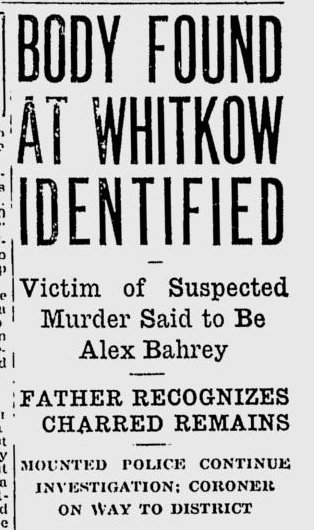
On April 16, 1933, Mike Swyck, a farmer in the Whitkow district of Saskatchewan, noticed his dog digging around in the ashes of his straw stack, which he had seen go up in flames from his farmhouse several days previous and decided to investigate. Peering into the ashes, he made a gruesome discovery. There, in the middle of the burnt straw pile, were the charred remains of a human body.
April 21, 1933 edition of the Saskatoon Star Phoenix
The body was burned beyond recognition but RCMP believed the remains belonged to Nestor Terecszuk, a man who’d been missing since the previous October. He’d been married to a woman named Annie Bahrey, but she’d separated from him after it came to light that he already had a wife, alive and well, back in Poland. The Bahrey family was furious with Nestor for this indignity to Annie, and coincidentally, on the same day of the fire, Annie’s brother Alec (sometimes referred to as Alex in the articles) had told their brother William (also called Bill) that he was going to hunt muskrats and had taken his horse and left. It seemed likely that Alec had killed Nestor and fled the law.
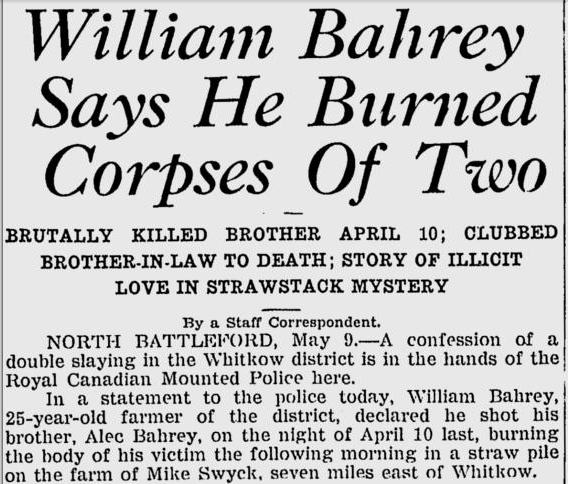
But when the remains were sent to the province pathologist, the estimated height, weight and age didn’t match Nestor. They matched Alec. And when Alec’s half-starved horse was found tied up in the bush with no trace of Alec, the RCMP turned their focus to Bill. When they told him they had proof that the body in the straw pile was not Nestor’s, Bill cracked and told them everything. And I do mean everything.
Alec was not the first man he’d killed.
Bill told RCMP that he’d also killed his brother-in-law, Nestor Terecszuk, the previous fall. After they’d found out about the bigamy, the family had been furious, as the locals described. But there wasn’t much legal recourse to take, aside from suing him for non-support, since proving their bigamy claim would involve bringing Nestor’s wife over from Poland, which would have been expensive.
Unwilling to let the man go unpunished and deciding that Nestor had no honour as a man, Bill found his opportunity in October of 1932, when Nestor visited Alec’s farm. He watched as Annie, Alec and his sister-in-law all left to visit his father, leaving Nestor on the farm alone. Bill took a .22 rifle and waited around the corner of the barn for Nestor. When Nestor approached, Bill stepped out from his hiding place and despite Nestor’s pleas, shot him in the gut. Nestor didn’t die. Instead, the two fought until Bill picked up the hub of a buggy wheel and clubbed Nestor with it, beating him in the head until he was dead. Bill dragged the body to the low ground below the house. Coming back later, he shot Nestor in the head with his rifle to make sure he was dead, then hooked a rope around the dead man’s feet and hitched the body to a horse, dragging it two and a half miles to a quarter section of land owned by another man, Pete Lemahl, where he threw it into the straw pile and burnt it.
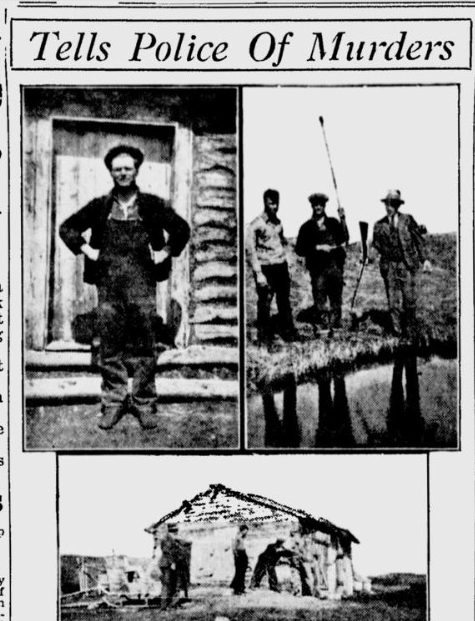
Bill took the RCMP to the straw stack where he’d dumped Nestor, and sure enough they found a lot of small bones, pieces of skull and bits of clothing and shoes in the ashes. Next, Bill took them to the creek where he’d thrown the rifle he’d used on his brother Alec, helping them fish it out of the water with a rake. After that, he showed them where in his father’s barn he’d hidden the bullets and took them to Mike Swyck’s, showing them where he’d hidden when he shot his brother.
May 10, 1933 edition of the Saskatoon Star Phoenix
Why did Bill kill his brother? The reason he gave was that he loathed Alec and was sick of watching him abuse and mistreat his wife. He’d seen Alec strike her countless times and at one point Alec had left his wife home alone the day after their child was born with no firewood in the house for them to keep warm. When she complained to him later that going out into the snow to try and get firewood in her state was dangerous, he told her he wanted her to die.
So, once again, Bill waited for his opportunity. It arrived on April 10, 1933. Mike Swyck told Alec he could have some beer bottles he had on his farm. When Alec went to the farm, Bill followed, and while Alec was gathering the beer bottles into two sacks he put by the straw pile, Bill took aim and fired. His first shot missed, but the next two didn’t. Bill left the body there, returning at night and tying a piece of wire around Alec’s arm and dragging him into the middle of the straw pile before setting it alight. A neighbouring farmer, John Masik saw the straw pile still burning the next morning but didn’t think enough of it to investigate.
The papers tried to play off his brother’s murder as a love triangle, saying that Bill was in love with his sister-in-law, Dora. But Bill never mentioned Dora in a romantic light when he told his story in court (and he certainly didn’t hold back on the details), and neither did Dora. Although in an interview with the provincial pathologist who worked on the case, there was mention that Bill confessed to a romantic relationship in his confession to police, so maybe it’s true. I have a hard time believing it, as he was said to have the mentality of a boy of ten.
Growing up, he’d only received two weeks of education and didn’t speak a lot of English. As well, the Whitkow district was described as bleak and desolate, without trains or phones and the highways were pretty well impassable in the winters. It’s entirely possible, given his isolation in that community, that he may not have understood the consequences of his confession. He certainly seemed to think his reasoning was sound.
If that was the case, his naivety didn’t garner him any mercy. He was sentenced to hang for the murders and despite several appeals by his defence, he did at 6:00AM on February 22, 1934 in Prince Albert.
May 13, 1933 edition of the Saskatoon Star Phoenix
And that concludes the tale of the Straw Stack Murders of Whitkow Saskatchewan. I read quite a few articles in the Saskatoon Star Phoenix to gather this information, using editions from April, May, September, October, November and December of 1933, as well as February of 1934. I also used an article in the October 22, 1955 edition of the Winnipeg Evening Tribune Weekend Magazine, in which provincial pathologist, Dr. Frances McGill gave an interview on the cases she’d worked.
If you’re wondering what started me on this murder research kick, I suggest you read my post, The Mystery of the Haunted Skull. If you’d like to read more strange and murdery tales from 1930s Saskatchewan, please check out the following posts:
As my hunt for the haunted skull of the Kerrobert Courthouse continues, there are certain keywords that are certain to grab my attention as I scroll through the piles of 1930s news articles. Axe murder is definitely one that makes me sit up in my chair. And in the spring of 1934, just over a month apart, there were two.
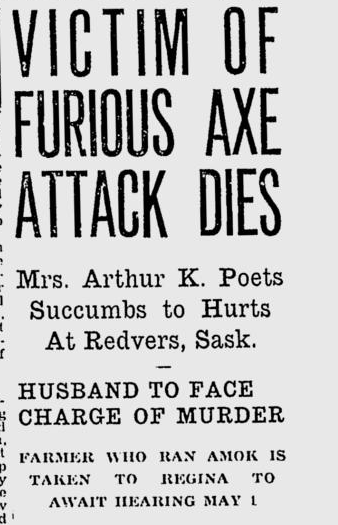
At approximately 3:00AM on April 23, 1934, Arthur Karl Poets, wielding an axe and a hammer, entered the home of his mother-in-law, Mrs. A Burr. First he struck Mrs. Burr in the forehead with his hammer, then attacked his brother-in-law, Alexander Burr. He then left the home, locked the only door in place and set the house on fire.
Why? His wife, Florence Burr Poets, had left him. She’d taken their two small children and gone to live with her mother after Mr. Poets mistreated her. What kind of mistreatment, the articles didn’t say, but given what happens next, I’ll let you use your imagination.
With the house now on fire, the family opened a downstairs window and crawled out, Florence’s younger brother, fourteen year old George, carrying out the two small children. The whole family managed to escape the blaze, but as Alexander came out of the house he was attacked again and knocked unconscious. This is when Arthur Poets turned his rage on his wife, hitting her multiple times with the axe and causing three deep gashes in her skull. Her mother, Mrs. Burr, ran to nearby Redvers and raised the alarm. Mr. Poets was arrested immediately, but sadly, Florence died within 27 hours of the attack, never regaining consciousness. She was only 23 years old.
The Saskatoon Star Phoenix, April 24, 1934
The second murder occurred on May 27, 1934, when Togo district farmer Fred Rezanoff stumbled home from the neighbour’s, drunk. According to his adult son, John, Fred got angry and struck his wife, Lena, with his fist. John intervened and took his mother home with him. Not long after, Fred showed up in their yard, axe in hand, and threatened to burn the house down if John didn’t send his mother out.
(Quick sidebar: what is the deal with disgruntled husbands and burning down houses? Dude, therapy.)
John went out to try to calm him, but Fred kept shouting, threatening to chop John’s toes off, so Lena came out and agreed to go home with him. John, more than a little certain that bad things were afoot, went straight to the barn with plans to go and get help.
Unfortunately, he had only just reached the barn when his wife, Annie started screaming for him to come back. Fred Rezanoff had struck his wife twice in the head with the axe. John and his wife tusseled with Fred and managed to overcome him and tied his hands and feet.
Lena Rezanoff lived for several days, long enough for surgeons to operate and remove pieces of bone from her brain, but she never fully regained consciousness and died from her injuries.
Fred was, of course, arrested. He told RCMP that he’d gotten drunk at the neighbour’s and couldn’t remember how he got home or anything leading up to the murder of his wife. He also claimed that for the past fifteen years he’d been experiencing dizzy spells which he cured daily with “fresh butter and honey”, but had recently run low on honey.
Now, I don’t want to be controversial here, but if there’s a possibility your drinking could lead to a blackout induced axe murder, maybe don’t?
The weirdest part of the story is how calm and unbothered Fred Rezanoff reportedly was through his arrest and trial. While his daughter-in-law, Annie, was giving testimony about what he’d done, he was apparently sitting calmly in his chair, playing with his infant grandchild.
Again, not to be controversial, but maybe don’t give the axe murderer a baby?
The Saskatoon Star Phoenix, Sep 29, 1934
Surprising no one, Fred Rezanoff was found guilty of manslaughter and given twenty years. The jury, upon reading the verdict, recommended the harshest possible sentence.
Neither axe murder was tried in Kerrobert, Saskatchewan, so the search continues. If you’re interested in more wild and weird tales of murder and mayhem in 1930s Saskatchewan, I highly recommend you also read:
All information about these murders were found in the April 24th, May 8th, 17th and 29th, June 14th and September 27th and 29th editions of the Saskatoon Star Phoenix in 1934. Thanks for reading! Please subscribe and share!
One of the many things bungee clipping my sanity together during this pandemic is my addiction to TikTok. The algorithm took almost no time to figure me out completely, which was both impressive and insulting. It keeps me on a steady diet of anything comedic and humor related, cosplay and fantastical makeup transformations, people making crafty things and sewing regency style dresses, and of course a hefty dose of women kicking ass. My two latest, favourite genres of TikTok content, however, could be deemed a little… strange.
First of all, I’ve become obsessed with @ladytaphos and her tombstone cleaning videos. (You can find her on Instagram too.) It’s exactly what it sounds like. She goes into old cemeteries and cleans old, illegible tombstones.
@ladytaphos Instagram
There’s something so hypnotic and soothing about watching her scrape the gunk off the old, weathered stone, scrubbing them with her brush, little eddies of soapy water running onto the ground. When she’s done, the tombstone looks bright and new again. It’s insanely satisfying to watch. Plus, I’m endlessly curious about the people those tombstones belong to. Do they still have family out there somewhere? Who were they? Were any of them murdered? (Yeah, I’m a little strange.)
I heard a saying a little while ago that we all die two deaths. Once when we actually die, and a second time when our names are spoken for the last time. I like that she keeps those tombstones clean and readable, so people will continue to say their names.
The second genre is probably even stranger. I love watching videos of people rescuing bees.
These earth angels go out on calls to collect bees that have built hives in barbeques, under floorboards, in old campers, (I even saw one where a hive was found in an old toilet tank) and move them into a hive box and take them somewhere safe.
As someone who’s spent their life generally terrified of all buzzing, stinging insects, I can’t imagine being so calm and serene around a misplaced hive of bees, but they always are. In one of my favourite beekeeper’s videos (@texasbeeworks), she pulls up the floorboards in an old shed to get at a gigantic hive, and after moving all their honeycomb over to their new hive box, she just starts scooping bees up with her bare hands and puts them in the new hive.
How can she… I just… What?
I’m sorry, but that woman is a total badass.
You’d think these videos would give me insane anxiety, thanks to my aforementioned fear, but they don’t. Like the tombstone cleaning, I find them endlessly soothing. The beekeepers I watch are clearly living their passion, calmly turning up to wherever they’re needed to save the bees. And no matter what kind of day I’ve had, watching them makes me feel hopeful.
As @texasbeeworks says at the end of nearly all of her videos, “it was another great day of saving the bees.” And you know what? She’s right. It was.
If you’ve been reading along, you know that I’m currently on a deep dive researching murders in Saskatchewan in the 1930s. (If you only just stumbled on my blog and would like to know what I’m talking about, read this and this.) Over the course of my research I’ve come across a lot of weird stories, but this one, while not a murder, was truly wild and I knew I had to share it with you.
In mid-November, 1931, RCMP officers arrested a man after they found him inside the opened coffin of a dug up grave, kissing the decayed face of his wife, who’d passed away in January of the same year. The man, Dmytro Stefaniuk, was charged with unlawfully interfering with the dead.
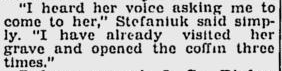
Dmytro told the officers that he’d heard “her voice, asking me to come to her” and admitted that this was the third time he’d dug up the grave to give his dead wife some affection.
At the time of his arrest, the officers found candles that he’d brought to burn for the repose of her soul, holy water to spinkle on her remains, and various articles of food, clothes and household effects, as well as a prayer book. He told them that he’d felt guilty for not providing her with those comforts in life and for not taking her to church, so he tried to give them to her in death.
His defense council, none other than John G. Diefenbaker himself, had Dmytro’s sanity tested and mental authorities found him fit to stand trial. Diefenbaker argued that Dmytro’s mind had been clouded by grief and he’d suffered temporary insanity as a result of his lasting affection for his wife.
Taking into consideration that Dmytro had already spent a month in prison since his arrest, the judge suspended his sentence, warning him not to heed the mysterious voice should he hear it compelling him to dig up the grave again in the future.
There was only the single article for this story, but upon reading it I had so many questions. Who was his wife? How did she die? And how did the RCMP know to find him in the graveyard? Did someone see him going in with his bag of supplies and a shovel and call the RCMP?
The article mentioned that Dmytro lived in the Sokal district of Saskatchewan, so I did a Google search for cemeteries in the area. I only found two listed, one was for Jehovah’s Witnesses, and the other was the Holy Trinity Ukranian Catholic Cemetery. Bingo.
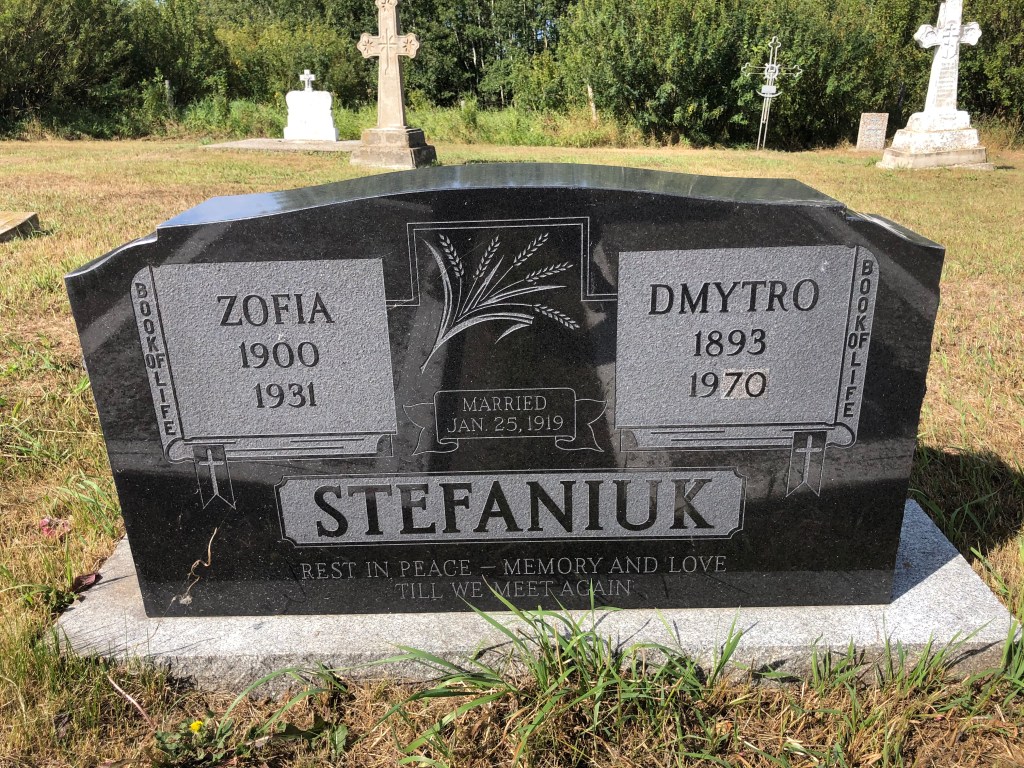
There were 157 graves listed for this cemetery on Find a Grave (a website that is exactly what it sounds like). I started scrolling through the list, looking for a woman with the last name Stefaniuk, whose year of death was 1931. And I found Zofia. Zofia Stefaniuk, born 1900, died 1931, buried alongside a Dmytro Stefaniuk, born 1893, died 1970. The entry included a picture of the tombstone, although I doubt it’s the original. It’s looks like it was replaced later to include Dmytro.
photo credit – FInd a Grave, uploaded by user DotM
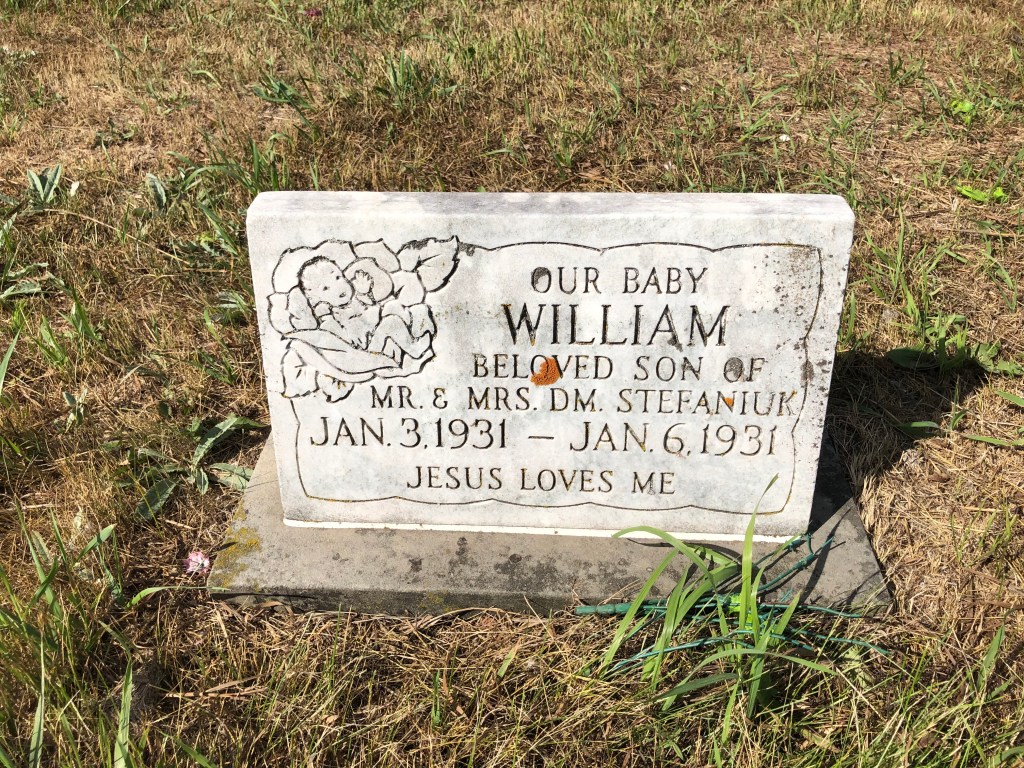
Another interesting item I found while scrolling was the tombstone for one William Stefaniuk, who lived for only three days in January, 1931. Born January 3rd, died January 6th.
photo credit – Find A Grave, uploaded by user DotM
Given that the wife of Dmytro died in January of 1931, could this be the reason why? Had she given birth to a son named William, and both died from complications of childbirth? I was unable to find an obituary for Zofia, so there’s no way to know for sure. Nor is there any way to be one hundred percent certain that Zofia was the woman to inspire such an unhinged level of devotion, but it seems likely.
Now I can’t help but wonder. Was it Zofia’s ghostly voice murmuring to Dmytro, demanding that he visit? Or was it as Diefenbaker said, a mind clouded with grief and guilt? I suppose we’ll never know.
Information for this post was found in the Dec 18, 1931 edition of the Saskatoon Star Phoenix.
Thanks for reading! For more wild stories of murder in 1930s Saskatchewan, as well as some more lighthearted and sarcastic content, make sure to subscribe! And don’t forget to share this post!
In this neverending pandemic, especially now with cases numbers blowing up in my province thanks to these fabulous new Variants of Concern and the turtle-slow rollout of vaccines, I find myself in need of escape. I read a very wide variety of books, but lately anything contemporary and based in reality is not appealing at all.
If you’re in the same boat, and would like a ticket to far different realities, I would like to present the following options. These made it into my tbr pile recently and I loved them.
A DEADLY EDUCATION – NAOMI NOVIK
If this is your first time reading Naomi Novik, congratulations, I’m very jealous of you. I’ve read all three of her books and will read every book she publishes from now until forever. Her characters are fantastic, her premises are fantastic, and I love her writing style. A Deadly Education is no different. I love everything about this book. The best part? It’s the first of a series (her other two books are stand alone) and the sequel comes out in June, so you won’t have to wait long for the next one. And in the mean time you can read her other two novels, Uprooted and Spinning Silver.
PIRANESI – SUSANNA CLARKE
Don’t ask me to say the title out loud, because I doubt I could get the pronunciation right, but this book is amazing. The best way I can describe it is it’s like one of those really strange dreams, filled with meaning, that you struggle to remember in the morning. The main character, Piranesi, spends the book puzzling out who he is and what his relationship is to the house he lives in, and its sole other occupant. It’s lyrical, hypnotic and really out there in the best way.
MEXICAN GOTHIC – SILVIA MORENO-GARCIA
I loved this book. It starts slow and grows more and more creepy and unnerving with an ever-expanding ball of dread in your gut, until you get near the end and everything jumps to hyper-speed and you’d rather cut your own eyelids off than stop reading. It’s strange and awful and beautiful and the writing is gorgeous. And the characters! Silvia Moreno-Garcia knows how to craft an insanely imaginative story and give you some truly repugnant characters. Magnificent.
There you have it! May these books serve you well in the coming weeks. Remember: stay in, read books, see no one.
Thanks for reading! If you like what you’ve read, remember to subscribe and share.
We are fast approaching spring, so I decided it was once again time to update you on my precious plant babies. (If you don’t know what I’m talking about, read this and this.)
Yes, I know that according to the calendar we are technically already in spring and I’m sure for a lot of you, it’s going wonderfully. But I live in Canada, and as I write this it’s currrently snowing outside my window, despite it being sunny and 13 degrees Celsius yesterday.
That’s just the way it goes here. Winter is like a bad ex-boyfriend. You thought you were pretty damn clear about the end of the relationship but it still just keeps showing up unexpectedly, accusing you of stealing its favourite sweater and asking if you’re seeing anyone. Oh my God, Winter! Just move on already! I’m with Spring now!
First off, I have a lot of Basil. And I’m still thinking of starting more. I’ve made pesto once already and it was so refreshing and delicious I’m thinking I should raise an army of Basil plants so I never have to go without. More basil, more pesto. More pesto, more better. Yes? Yes.
My butternut squash are doing reasonably well, as are my rosemary. I even got to harvest a squash blossom already, and there are plenty more blossoms on the way. (Stuff them with ricotta and herbs, dip in a little batter and fry. So good!)
For flowers, I’ve got an Ageratum mix and some Peppermint Stick Balsam, both doing super well. The rest of my flower seeds are direct sow, which I will hopefully be doing soon. (No, you didn’t forget your keys here, Winter. Ugh.)
AgeratumBalsam
That’s it for now! And if Winter tries to ask you for my new number, tell it to get bent.



















 Melanie Cole