The Mystery of Mrs. Pengelly

On the morning of September 16, 1928, Fred D. Ross, a farmer near Lockwood, Saskatchewan, woke up to things feeling a bit strange. It was 10:30 a.m. and even though it was a Sunday, he was still a little surprised to see that no one was about.

He got up and made himself some breakfast, then went out to do the chores. As he entered the feed yard, he came upon a horrific sight. The body of Vera Pengelly, one of his employees, was lying by an oat stack. A rifle was resting loosely in her arms, her hands growing stiff around it, with the muzzle resting close to one ear. There was a bullet hole in her forehead, as well as another wound on her face above the gun shot.

Ross immediately went back to the house and got his two farmhands, Bob Smale and Vera’s husband, Albert (also saw his name listed as Borge and Borze). He took them down to see what had happened, then the three returned to the house to call the authorities.

The death was labeled a suicide and Mrs. Vera Pengelly was buried without an inquest. But her parents, Mr. and Mrs. I. E. Inger, were suspicious. To them, it didn’t sound like a suicide. They pushed for an investigation and on January 23, 1929, an exhumation of the body was ordered.

Vera Pengelly had been laid to rest in a cemetery in Foam Lake, near her parents. Her body was exhumed and on January 31, 1929, Dr. W. S. Lindsay performed an autopsy.

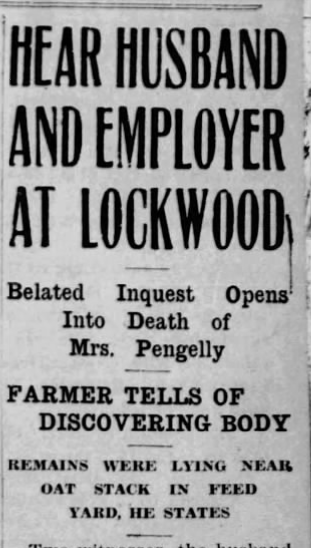
A Coroner’s Inquest was formerly opened on February 5, 1929.
The Saskatoon Star-Phoenix – Feb 7, 1929

Fred Ross testified, taking the jury through his waking late on that Sunday morning to finding the body and telling Mr. Pengelly. He said that when he told Pengelly about his wife, Pengelly did not show much distress or excitement, which he found odd. After Vera died, Pengelly left Ross’s employ and moved to Foam Lake.

Albert Pengelly of course testified as well. He and Vera had married in 1927 and were employed shortly after by Ross on his farm, eight miles from Lockwood. On the day in question, he and Smale got up at 5:00 a.m. to go duck hunting. They took shotguns, but it was too cold and they didn’t find any birds, so they gave up and returned to the farmyard at about 6:15 a.m. They did the chores, then returned to bed, some time on or about 6:35 a.m.

Pengelly and his wife shared their room in the farm house with Vera’s sister, Ethel. (In some articles, Ethel was listed as Albert’s sister, not Vera’s). When Albert returned to bed, Ethel remained asleep but Vera woke up. The couple talked about visiting some neighbours that day and as he started to fall back asleep, he noticed Vera sitting up as if she were about to get up. He coaxed her into going back to sleep with him and the last thing he remembered was that she seemed to be about to get up and had kissed him. The next thing he knew, Ross was waking him up to tell him about finding Vera’s body. He told the jury that he’d gone to the body and thrown himself before it, touching the arms.

He could give no reason for her suicide, but did mention that they’d lost a baby several months ago.

Bob Smale also testified, saying that Pengelly did not seem excited or emotional when informed of his wife’s death. He’d noticed blood on Vera’s face and left hand.

Ethel, Vera’s sister, had slept through everything. She testified that Vera had not been feeling well since the death of her baby. She said she often heard Vera saying that “if she did not care for Bert, her husband, so much, life would not be worth living.”

A neighbour, John Howat, testified. He said that when he arrived, the rifle barrel was about three inches from the woman’s chin. An eye was black. There was a bullet wound in the forehead and another wound as well. He said there was blood on both hands, and to him, it looked as though it had been rubbed there. There was blood on both arms, on her hair and her sweater. According to John, the scene felt wrong and he didn’t want to touch anything.

Dr. Hicks had been the first doctor to arrive at about 12:15 p.m. and confirmed that there was blood on her hands and that it looked as if it were rubbed there. There was a wound on the forehead and another on the back of the head under the hair, both of which seemed to have been caused by a sharp instrument but didn’t penetrate the skull. He and the other doctors believed these wounds occurred while she was still alive, but couldn’t say if they were before the gunshot or afterward as she fell.

The rifle that had killed Vera was a .22 caliber and belonged to Ross. Vera had used it before, when she went rabbit hunting with her husband. The police had found two plunger marks on the spent cartridge, indicating that the first attempt to fire the rifle had failed.

Dr. Lindsay testified as well, and stated that because there was a noted absence of powder marks anywhere on Vera or her clothes, he didn’t believe it was possible that she was the one who fired the weapon.

With all this information, the jury at the Coroner’s Inquest ruled the death a murder and the police began investigating.

The Saskatoon Star-Phoenix – Feb 8, 1929

There wasn’t a lot for the police to go on. There were some rumors of a frightful row at the farm that morning, but Ross and Smale said they’d never seen Pengelly and his wife argue. A man named Godfrey Thompson had been at the farm that morning and refused to go with the other men to see the body, because he didn’t want to get caught up in the matter. This rubbed some people the wrong way, and it was labeled as suspicious.

Despite the verdict at the inquest, the police never really believed that it was anything other than suicide, and by October 31, 1929, they admitted to reporters that due to the lack of evidence, they were no longer working on the case and had labeled it a suicide.

And that is the story of the mysterious death of Mrs. Vera Pengelly. Was it murder? Or did Mrs. Pengelly succumb to the grief over her lost child? Only she will ever know.

The Saskatoon Star-Phoenix – Feb 9, 1929

Thank you for reading! If you enjoyed this post and don’t want to miss future true crime stories, please subscribe! Don’t forget to send it to friends!

Information for this post came from the following editions of the Saskatoon Star-Phoenix: Feb 6, 1929, Feb 7, 1929, Feb 8, 1929, Feb 9, 1929, Feb 11, 1929, Feb 16, March 2, 1929, Oct 31, 1929

Want to read more true crime stories from historical Saskatchewan? Give these a try:

The Brutal Murder of Florence Beatty

The Bath Tub Murders

The Murder of the Bromley Five

The Brutal Murder of Florence Beatty

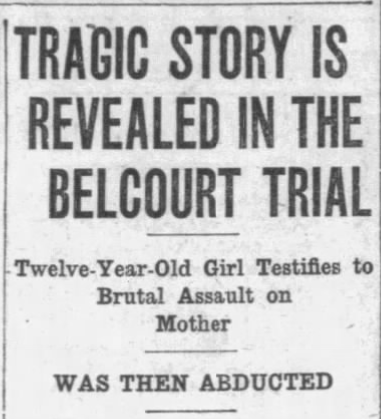
On September 3, 1918, Edward Beatty took his smallest son and went to Yorkton, leaving his wife, Florence, their 12-year-old daughter, Thelma, and their two other sons, Ronald and Tyrel, at home in the Beaver Hills Forest Reserve, 22 miles from the village of Theodore. Edward was a fire ranger in charge of the Beaver Hills Forest Reserve and had employed a man named Barney Belcourt (also seen spelled Bellcourt and Bellecourt), who lived with him and his family. He’d been working for Edward for some time and was considered trustworthy and a member of the family.

Unfortunately, Belcourt was anything but trustworthy. He’d grown infatuated with the Beatty’s young daughter and had expressed a desire to marry her, which was obviously met with opposition and dismissed.

On the night of September 3rd, Thelma was awakened by the sounds of a struggle. Belcourt had beaten Florence Beatty in the head with a blunt instrument and despite putting up an incredible fight to protect her daughter, Thelma watched as he dragged her mother across the floor from the kitchen to the cellar door in the dining room. He shoved her head-first down the stairs into the cellar, then nailed down the cellar flap.

The Saskatoon Daily Star – Sep 7, 1918

He then made Thelma carry a lamp while he moved the youngest child to another bed and collected both his and her clothing and gathered some food. He made her go out to the barn where he had two of the Beatty’s horses hitched to a rig and took her four miles from home where they made camp. He kept her until the following evening, raping her several times throughout the day. As evening grew near, he worried that harvest laborers might see them and drove her to about four miles from town, where he let her go.

Meanwhile, that same morning, Ronald and Tyrel had woken up and gone searching for their mother. They checked all over the farm until they finally pried up the cellar door flap and found her at the foot of the steps unable to speak. Florence had lain all night at the bottom of the stairs with a fractured skull, in the dark, damp cellar. The boys tried to call for help but the telephone wire had been cut.

They managed to get help and Florence was taken to Theodore. She died that afternoon from her injuries, on Wednesday, September 4, 1918. At sundown that same day, Thelma walked into town and told police that Belcourt had dropped her off four miles from town and a manhunt was organized.

The Regina Leader-Post – Sep 5, 1918

Every available man, armed with shotguns and rifles, joined the hunt. Bloodhounds were brought in to help with the search. The trees in the Beaver Hills Forest Reserve were plentiful and grew close together, providing lots of places to hide. But with so many volunteers searching the area, Belcourt was located and captured without a fight the following day, on September 5, 1918.

He was taken to Regina jail when threats of lynching were made and police feared the community would try to take justice into their own hands. He was brought back to Theodore on September 13, 1918 for his preliminary hearing and was committed to stand trial at Melville.

His trial opened soon after on October 1, 1918 before Justice McKay. The prosecutor was H. E. Sampson and the defense was Mr. Smith of Yorkton. Thelma and her brothers testified, as well as the coroner about Florence’s injuries, and on October 3rd, Barney Belcourt was found guilty and sentenced to hang on January 8, 1919.

The Regina Leader-Post – Sep 7, 1918

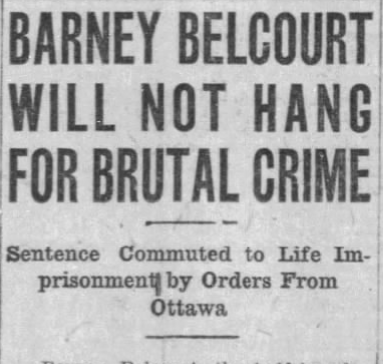
It’s unclear why, but Barney Belcourt’s sentence was commuted to life in prison on December 30, 1918 and he was taken to Prince Albert Penitentiary to serve out his sentence.

And that is the story of the horrific murder of Florence Beatty.

The Regina Leader-Post – Dec 30, 1918

Thank you for reading! If you enjoyed this post and don’t want to miss future true crime stories, please subscribe! And don’t forget to share it with friends!

Information for this post came from the following editions of the Saskatoon Daily Star and the Regina Leader-Post: Sep 5, 1918, Sep 6, 1918, Sep 7, 1918, Sep 9, 1918, Sep 12, 1918, Sep 13, 1918, Sep 14, 1918, Oct 1, 1918, Oct 4, 1918, Oct 7, 1918, Dec 30, 1918, Dec 31, 1918

If you’d like to read more stories of historical true crime in Saskatchewan, give these a try:
The Bath Tub Murders

The Murder of the Bromley Five

The Mysterious Murder of the Hansons

The Bath Tub Murders

Did you know that there’s a Saskatchewan connection to the infamous Bath Tub Murders of 1912-1915? I was browsing the newspaper archives the other day, came across an article and then of course had to tell you about it.

The Boston Daily Globe – April 18, 1915

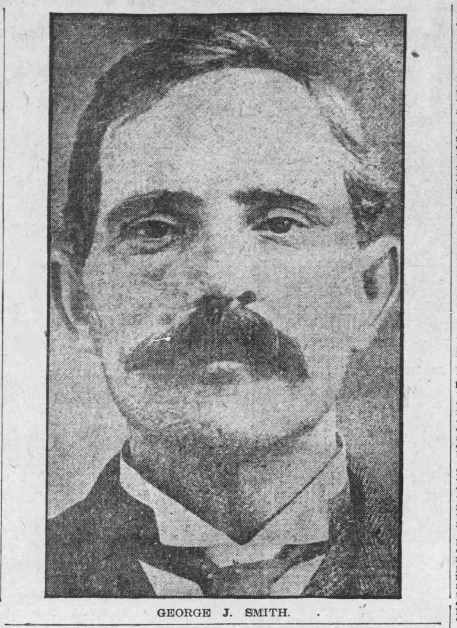
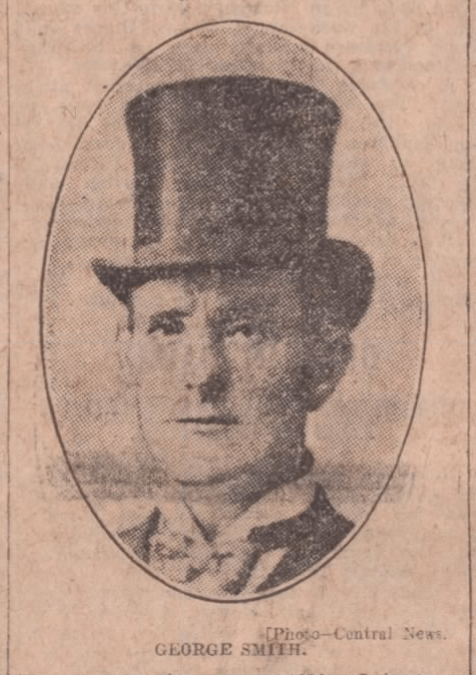
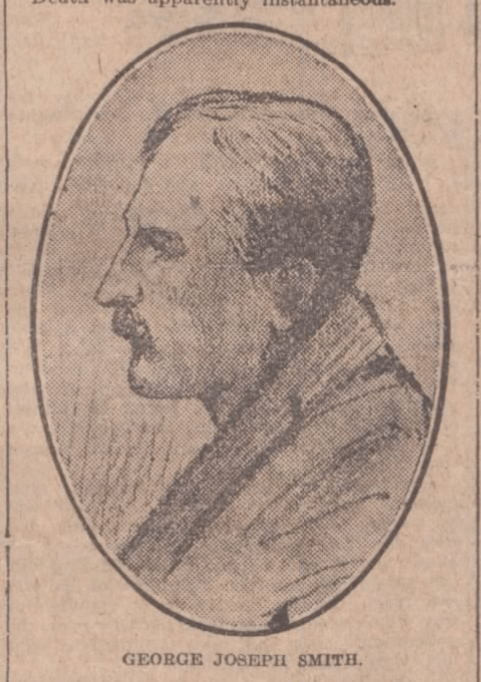
George Joseph Smith was a serial killer and bigamist born in Bethnal Green, London in 1872. He started his criminal career very early, committing acts of theft and fraud.

In 1898, under the alias George Oliver Love, he married a woman named Caroline Beatrice Thornbill in Leicester. The couple moved to London, where George immediately sent Caroline off to work as a maid so she could steal for him from her employers. She was eventually caught and sentenced to 12 months. Upon her release, she incriminated her husband who was sentenced to two years in January 1901. Terrified of her husband, she fled to Canada when he was released and ended up living in – you guessed it – Saskatchewan.

In 1908, he married two women. First was Florence Wilson, a widow from Worthing, whom he married in June. He left her a month later on July 3, but not before drawing money from her savings account and selling her belongings from their Camden Town residence in London. By July 30th he was getting married again, this time to a woman named Edith Peglar, who’d answered his ad for a housekeeper. Between all his other marriages, he would always return to Peglar, bringing money.

Smith repeatedly married women and cleared out their bank accounts before disappearing, until the day he came up with a much more sinister plan. In 1910, he’d married a woman named Beatrice Mundy under the alias Henry Williams. She was living off the interest of an inheritance from her mother, an inheritance he desperately wanted to get his hands on. When her family refused, he stole approximately $500 worth of gold from her and left.

In March of 1912, he ran into her again. He begged her for forgiveness and persuaded her to give him a second chance. This time, he convinced her to make him the beneficiary of her will, leaving him her inheritance in the event of her death. He rented a home for the two of them in Blackpool, and when the wheels were in motion for getting the will made up, he rented a bathtub and had it sent to their home. Weeks later, the will now made and sealed, he took his wife to a local doctor, saying she suffered from epileptic seizures, although she only complained of a headache. On July 12, 1912, he came and woke the doctor, saying his wife was having another seizure. The doctor checked on her and promised to come back the following afternoon, but the next morning he was informed by Williams that his wife had died.

The doctor went to the house and found Beatrice in the tub, her head under water with her legs stretched out straight and her feet out of the water. There were no signs of violence, so the doctor attributed the drowning to epilepsy and Williams was awarded his wife’s money, as was listed in her will, drafted five days before her death.

The Liverpool Echo – March 23, 1915

In September of 1913 George met Alice Burnham and by November they were married. He soon convinced her parents to send the $500 she had saved and convinced Alice to get life insurance in his favour. On December 10th, they arrived in Blackpool and George enquired at boarding houses until he found one with a bathtub. The next evening, Alice told the landlady she would like a bath. The landlady drew the water, then went downstairs. George came into the kitchen a little while later, telling her that he’d been out to buy eggs for breakfast. He went upstairs and soon began calling for the landlady. The woman ran upstairs and found him holding his wife’s head. She thought it odd that the woman, in a boarding house full of strangers, hadn’t locked the bathroom door to take her bath.

George Smith testified at the inquest on December 13th and the death was ruled a drowning.

On September 17, 1914, George married a woman named Alice Reid using the name Olive Charles James and three months later he married another woman, Margaret Lofty, using the name John Lloyd. Soon after their marriage, Margaret had a will drawn up with George as the sole beneficiary and three hours later, she was dead. She’d also withdrawn all of her savings that same day.

Apparently, the couple had gone on a walk, and when they returned to their boarding house (at which George had specifically requested to inspect the bathtub before getting a room), Margaret asked the landlady if she could have a bath. The same scenario repeated itself, this time with George telling the landlady he’d been out buying tomatoes, before going up and ‘finding’ the body of his wife. Once again, the landlady thought it was odd that the bathroom door was unlocked.

In January of 1915, Division Detective Inspector Arthur Neil received newspaper clippings for the deaths of Margaret Lofty and Alice Burnham with requests to make an enquiry. He inspected the tub where Margaret Lofty had perished and found it rather small, too small he thought, for a woman to drown in. He investigated both deaths and after realizing that their husbands matched the same description, he had the insurance for Margaret Lofty released so he could stake out the insurance company. When ‘Mr. Lloyd’ arrived to collect the life insurance, Neil was waiting for him and got him to admit that he was also the husband of Alice Burnham. At that point, George probably thought that the worst he’d get caught for was bigamy. But as Neil continued his investigation, he found out about the drowning of Beatrice Mundy as well and the deaths became far too coincidental to ignore.

None of the women had any defensive wounds on their bodies, certainly nothing that would have shown up after the frantic struggle of someone being held under water. But it was from the description of Beatrice Mundy’s body when she was discovered in the tub that the answer was eventually discovered. Neil figured out that George would grab the women by the ankles and suddenly yank them forward, causing their head to go underwater and the water to rush up their nose, resulting in them immediately losing consciousness and drowning without a struggle.

The Boston Daily Globe – March 24, 1915

George Smith went on trial for the three murders on June 22, 1915. His first wife, Caroline Thornbill, was called back from Saskatchewan to testify. He was found guilty on July 1, 1915 and was hanged on August 13, 1915.

The Liverpool Echo – Aug 13, 1915

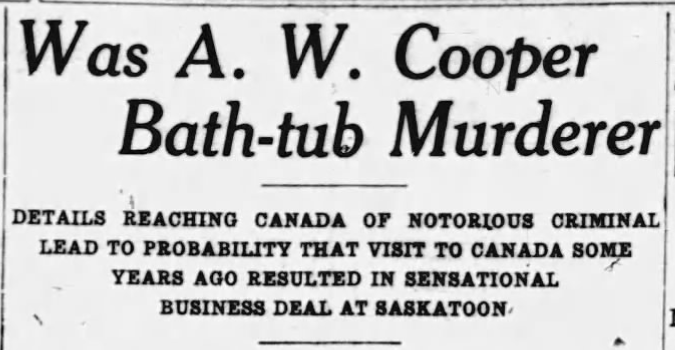
It was in September of the same year that journalists in Saskatoon put together that George Smith might have spent some time in their city. A man that matched George Smith’s description going by the name of Arthur William Cooper arrived in Saskatoon in 1908 and purchased a store from a Mr. B. A. Archibald with a forged letter of credit. He took possession of the store and started selling off the stock at ridiculously low prices and ordering more from wholesale firms. When these firms became suspicious and asked the local bank to cable the London bank for verification of his notes of credit, the reply came back as unknown. The man, whose real name was William George Smith (or so he said), was arrested and released on $200 bail. He immediately disappeared. Apparently, George Smith’s wife, Edith Peglar, confirmed that he’d disappeared for a while after their marriage and when he returned he’d told her he’d been in Canada, but there’s no way to know for sure if it was the same man.

The Saskatoon Daily Star – Sep 16, 1915

And that’s the story of the Bathtub Murders and their small connection to Saskatchewan!

Thank you for reading! If you enjoyed this post and don’t want to miss future true crime stories, please subscribe! And don’t forget to share it with friends!

Information for this post came from the Wikipedia page for George Joseph Smith and the following editions of the Saskatoon Daily Star: April 17, 1915, June 25, 1915 and September 16, 1915. Pictures came from Wikipedia, the Boston Daily Globe, and the Liverpool Echo.

If you’d like to read more historical true crime from Saskatchewan, give these a try:

The Murder of the Bromley Five

The Mysterious Murder of the Hansons

The Murderous John Bronch

The Murder of the Bromley Five

Content Warning: The following true crime story deals with the murder of children. If that will be upsetting for you, please read no further and join us next Tuesday for the next true crime installment. Thank you and take care of your mental health!

Let’s begin.

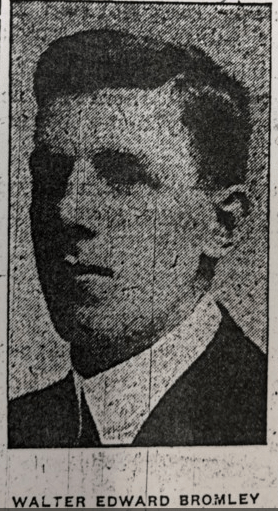
On the evening of September 17, 1918, Walter Edward Bromley sent his wife to the picture show. It was her first time out of the house since the couple and their five children had moved to Moose Jaw, Saskatchewan in April. He was described in the newspapers as a driver for the Dominion Express Company, but in an article from Moose Jaw Today, he was said to have worked for the Canadian Pacific Railway. In either case, his wife left him at home with the children and went out for a much deserved break.

When she returned to their little two-story house on Ominica Street East at about 11:30 p.m. Bromley met her in the road and refused to let her inside, telling her he’d killed their children. She started screaming, rousing the neighbours and bringing them out of the house to see what was going on. A crowd gathered and the police were summoned. Around this time, Bromley led his wife away, walking east towards the cemetery. She walked for some blocks, dazed and in shock. He began telling her the story in all its horrid details and she pleaded with him to surrender to the police. He did, walking into the station with his wife shortly after midnight. In his pocket was the fateful razor blade, still covered in his children’s blood.

The Regina Leader-Post – Sep 19, 1918

What the police found inside the home was a horrific sight. According to Bromley, he had been reading while his children played. His son, Norman, who was about 9-years-old, was playing upstairs when he started crying. His father told him to stop, but the crying continued. In a fit of rage, he rushed upstairs, seized his razor and cut the little boy’s throat. He threw the child on the bed and then, supposedly realizing what he’d done and becoming overwhelmed by fear, distress and horror, he decided to exterminate the rest of the children.

He went to the room where his 14-month-old twin daughters, Doris and June, were sleeping and took them one by one to the bedroom where his son lay and did the same, cutting their throats before placing them on the bed with their brother. The last two children, Dulsie and Ivy, aged 7 and 5, were also asleep. He killed them both in the same way.

The Winnipeg Tribune – Sep 21, 1918

Bromley told police that he’d intended to kill himself as well, but his resolve weakened and instead he washed up and changed his clothes before waiting for his wife to come home.

But the police weren’t entirely convinced of Bromley’s tale of sudden insanity brought on by his son’s crying. As they searched the home, cataloguing the brutal violence within (the newspapers described the wounds on the children as being so deep they were nearly decapitated), they found an axe lying on a dresser in one of the upstairs bedrooms. It was new, having never been used before. Furthermore, they found a man’s shirt, the back and tail of which were saturated with blood. When Detective Hugh Johnstone questioned him about it, Bromley told him he’d tied it around his waist to protect his clothes as a make-shift apron, before he went upstairs with the razor and the axe. To the police, this showed premeditation.

The Winnipeg Tribune – Sep 21, 1918

At the inquest, his wife testified that Bromley had told her he’d killed the children so that they wouldn’t freeze in the coming winter. He’d told police that he was worried over financial matters, the $25 rent for their home was due on September 19th. Apparently, he’d recently been demoted, unable to handle the responsibilities at his job and now was struggling to make ends meet.

Walter Bromley was given a preliminary hearing at Moose Jaw on September 20, 1918. He was brought into court dazed and unshaven, with his hair tousled and looking generally haggard. He was about 5’9″, with a slender build, narrow chin and light red hair. Not someone that at first glance seemed capable of such violence.

The Moose Jaw Daily News – Aug 16, 1919

When Detective Hugh Johnstone testified about the bloody shirt used as an apron, it came out that he’d neglected to issue Bromley the necessary warning before questioning him. Bromley had been given the warning before his confession, but Johnstone should have given it again when he returned to question him in his cell. All mention of Bromley’s interview about the shirt was ordered deleted from the evidence.

Bromley was committed to stand trial and was taken to the Regina jail.

The Regina Leader-Post – Sep 23, 1918

On October 18, 1918, Detective Hugh Johnstone died of pneumonia. He was intended to be a prominent witness in the case. The trial experienced another set back when it was postponed from November of 1918 to January of 1919, due to the influenza epidemic. Bromley’s defense attorney, Walter Mills KC, asked for further adjournment on January 31, 1919, in order to secure evidence from England regarding a history of insanity in Bromley’s family. It was granted and the case was adjourned until the next sitting.

During this time, Mrs. Bromley was hospitalized. Unsurprisingly, she’d suffered a nervous breakdown after the murder of her children. When Bromley’s trial at last took place on May 15, 1919, she was well enough to attend.

The trial was short, lasting a single day. Bromley entered a plea of not guilty, his defense arguing that he had suffered from homicidal insanity at the time.

Walter Bromley took the stand and stated that mental illness ran in his family, pointing to an uncle born with an intellectual disability. On cross examination by acting Crown Prosecutor Rose of Weyburn, Bromley admitted that he’d murdered his children, declaring that he couldn’t give a motive.

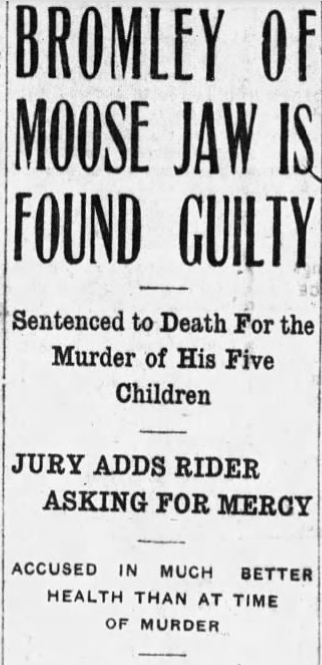
That evening, the jury found Bromley guilty, with a recommendation for mercy, and the judge sentenced him to hang on August 21, 1919.

The Saskatoon Daily Star – May 16, 1919

Bromley’s defense, Walter Mills, continued to work hard on his behalf, asking for a reprieve. He believed there was strong evidence of mental illness. His request was granted and on August 16th Walter Bromley’s sentence was commuted to life in prison.

And that is the story of the murder of the Bromley children.

The Regina Leader-Post – Aug 16, 1919

Thank you for reading! If you enjoyed this post and don’t want to miss any in the future, please subscribe! And don’t forget to send it to your friends!

Information for this post came from a September 22, 2022 article in Moose Jaw Today (linked above) and the following editions of the Regina Leader-Post, the Moose Jaw Daily News and the Saskatoon Daily Star: Sep 18, 1918, Sep 19, 1918, Sep 20, 1918, Sep 21, 1918, Sep 23, 1918, Sep 25, 1918, Oct 19, 1918, Oct 22, 1918, Jan 28, 1919, Jan 29, 1919, Feb 1, 1919, Feb 3, 1919, May 13, 1919, May 16, 1919, Aug 4, 1919, Aug 5, 1919, Aug 16, 1919

If you’d like to read more historical true crime from Saskatchewan, give these a try:

The Mysterious Murder of the Hansons

The Murderous John Bronch

The Terrible Acts of John Wowk

The Mysterious Murder of the Hansons

On Saturday afternoon, November 22, 1919, Fred Hanson and his wife got in their automobile and drove into Lemberg from their farm, located about halfway between Lemberg and Abernethy in Saskatchewan. They stayed in town until after supper, then prepared to return home. As they were getting ready to leave, they invited Joseph R. Sullivan to join them and spend Sunday at their farm. He agreed. Sullivan was a grain buyer in Lemberg and had known the Hansons for some time, having lived near them in Wisconsin fourteen years previous.

The group made it about halfway home before they got stuck in a bad place on the road. Unable to get the vehicle moving again, the three decided to walk the rest of the way to the Hanson home, arriving at about 3:00 a.m. At this point, Mrs. Hanson quickly put together a “light lunch” for the two men, which they sat down and ate.

When they were finished, Fred Hanson decided to go to the barn and check on the stock. Sullivan told him he’d help and the two men walked out to the barn. About five minutes later, Sullivan returned to the house, telling Mrs. Hanson that one of the horses had killed her husband and she’d better come out and see. She woke up her eldest son, Alfred, who was only 14, and together they started for the stable with Sullivan following behind.

As Mrs. Hanson stepped into the stable, she saw her husband’s body on the floor and heard him groaning. It’s impossible to say if she had time to process the fact that he’d been shot, not trampled, when she turned to face Sullivan and was immediately shot in the head. She fell to the ground in a heap, leaving only Alfred, who’d been standing in front of her.

The Regina Leader-Post – Nov 24, 1919

Sullivan leveled the revolver again and fired, hitting Alfred in the neck. Alfred ran in front of the horses and hid in the manger, but Sullivan followed and dragged him out. He told Alfred he wouldn’t hurt him further, but told him to keep his mouth shut.

Next, Sullivan went to the house and rounded up the other three children, Florence, who was 18, Clara, who was 16, and Edward, who was 13, and ordered them into the backroom. They huddled together, crying, as he brandished the gun a couple of times, making wild gestures. All of a sudden, he stopped short and ordered them to get out of the house, telling Florence as she left that her parents and brother were dead in the barn.

As the three headed for the barn, they heard a shot from in the house. Florence could hear the sounds of a faint cry and they followed it, finding Alfred, who’d managed to make it to the coulee. She sent her siblings ahead to the neighbour’s and stayed to help her brother, bringing him back to the barn.

Clara and Edward ran to their closest neighbour, Bert Atkinson, and told him what had happened, then headed back without waiting for him. They found Florence and Alfred in the barn, attending to their father, who was still alive.

Florence decided to go and check on what was happening in the house, sneaking up and peering in through the windows. The house was all dark except for a faint light in the bedroom. She crept to the bedroom window, and carefully peeking inside, saw a body on the floor.

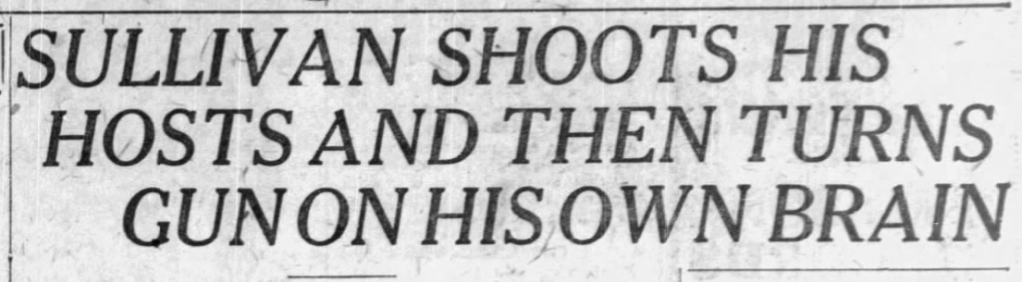
At this point, Bert Atkinson arrived and he and Florence went inside the house, where they found Sullivan dead in a pool of blood in the bedroom. There was a hole in his temple, the revolver still tightly clasped in his right hand. It appeared that after ordering the kids from the house, he’d gone and sat down on a chair in the bedroom and shot himself, his body falling forward onto the floor and ending up in a somewhat huddled position.

The Regina Leader-Post – Nov 24, 1919

Bert had called and notified Constable Larocque at Balcarres, Coroner Canopy at Abernethy and Dr. Symes. Fred Hanson did not survive his injuries, but Alfred did, recovering slowly from the gunshot wound in his neck.

Constable Larocque attended the scene with Constable Laight of Melville and Corporal DesRosiers. The police believed the murders had been planned and that Sullivan had waited for an opportunity. The motive was a mystery, although they guessed it was due to some long standing grudge Sullivan had been keeping. As far as the community knew, Sullivan was a friend of the Hansons, and they were described as being on the best of terms.

And that is the story of the mysterious murder of the Hansons.

The Regina Leader-Post – Nov 26, 1919

Thank you for reading! If you enjoyed this post, please subscribe and send it to your friends!

Information for this post came from the following editions of the Regina Leader-Post, Saskatoon Star-Phoenix and Saskatoon Daily Star: Nov 24, 1919, Nov 26, 1919, Nov 27, 1919, Nov 28, 1919

If you’d like to read more historical true crime from Saskatchewan, give these a try:

The Murderous John Bronch

The Terrible Acts of John Wowk

The Shooting of Alex Shulman

The Murderous John Bronch

A few weeks ago, I wrote about The Murder of Arnold Gart, in which Gart was stabbed to death in broad daylight with countless witnesses. His murderer, John Bronch, went free, thanks to The Unwritten Law. And I assumed that was the last we’d hear ever hear of him. But no, it seems that Bronch wasn’t finished. His arrogance at getting away with murder appears to have led him to thinking he could do it again.

In the beginning of February, 1924, he was given a preliminary hearing at Hafford and committed to stand trial for attempting to procure the murder of his wife, Augustine Bronch. He was released on $20,000 bail until his trial.

The Saskatoon Star-Phoenix – Feb 4, 1924

The couple were married in North Dakota 19 years previous, and had 12 children together, although only 10 of them were alive at the time of the preliminary. In April of 1923 they were separated because of spousal abuse. Augustine testified that Bronch had threatened to kill her with a knife, as well as regular ill treatment. (As you may recall from my previous post, their marriage was not a peaceful or healthy one. It appears Bronch positively sucked as a husband and partner.)

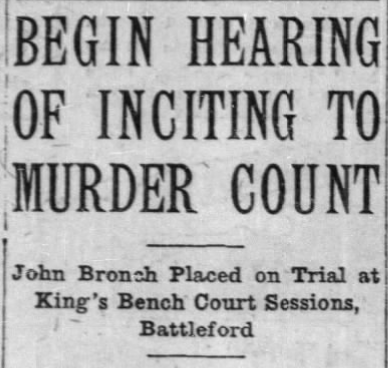
Bronch’s trial began on February 26, 1924 in Battleford before Judge Maclean.

The Regina Leader-Post – Feb 27, 1924

The main evidence in his trial was the testimony of Alex Werezak (also seen spelled Worashak). He told the court that on January 15, 1924, John Bronch had come to his farm and given him an old, obsolete revolver and a flashlight. Bronch told him to go to the house where his wife was staying at Maymont, rap at the door, and when she opened it, shine the flashlight in her eyes and shoot her through the heart. He was then to throw the old revolver away. Bronch paid him $220 and promised another $80 when she was disposed of.

Apparently Bronch was expecting a young widow from the Old Country and wanted his wife out of the way so he could start a new marriage.

On February 28, 1924, the jury announced they were unable to reach a verdict. A new trial was scheduled and began on May 14, 1924 before Judge H. Y. MacDonald in Battleford.

The Regina Leader-Post – May 15, 1924

Alex Werezak gave his same testimony, telling the court about being tasked with the murder by Bronch. He admitted he’d spent the money, then his conscience began to eat at him (as well as his fears that his wife was being indiscrete) and he told the police. Augustine Bronch also testified, telling the court about the abuse and cruelty she suffered at the hands of her husband. She stated that while they were well off, he was a poor provider, and she had to work outside the home for two years before the separation. It appears her husband was hell bent on punishing her for her alleged dalliance with Gart.

(Let me just note, that while I don’t condone cheating on a spouse or partner, in instances such as this one where there is a clear, unbalanced power dynamic, with Augustine being at the literal mercy of a man who thought of her as property, I hold no judgement against the subjugated partner for their attempts to find happiness wherever they can.)

The police produced a stocking that had been wrapped around the revolver when Bronch gave it to Werezak. They identified it as belonging to Bronch and testified that the revolver matched the description of a revolver Bronch had inherited from an ancestor, but couldn’t say for certain that it was his.

Bronch, of course, denied everything. His son was called as witness and testified that all the arguments he’d seen between his parents were his mother’s fault. He said he’d never seen his father ill use his mother and stated that his father had tried to get Augustine to return multiple times.

This time, the jury didn’t buy it and on May 16, 1924, they found John Bronch guilty. He was sentenced to five years in the penitentiary. Let’s hope that finally facing some consequences did him some good.

And that is the story of the attempted murder of Augustine Bronch.

The Regina Leader-Post – May 17, 1924

*Update: Thanks to the beauty of social media, one of the members of my Facebook group, Historical Saskatchewan True Crime, recognized the name John Bronch (also spelled Bronsch or Brunsch) and did some digging. It turns out, Augusta (as she was known to her family) and John are her husband’s great grandparents! John’s criminal past was kept a secret, with John’s youngest son, Fred, telling a family member on his deathbed. None of the rest of the family were ever made aware of the fact that John had once murdered a man in broad daylight and later tried to have his own wife killed! Augusta was only 17 when she and John were married in North Dakota, he was 34.

Unfortunately, Augusta died in 1927 or 28. She was only 49 or 50. John got out of prison and in 1929 purchased land in North Battleford. He gave his land in Radisson to his sons and moved with his three youngest children and his parents to North Battleford. He died in 1934. She was kind enough to provide the following pictures from the Radisson history book:

Thank you for reading! If you enjoyed this post and don’t want to miss any in the future, please subscribe!

Information for this post came from the following issues of The Regina Leader-Post and Saskatoon Star-Phoenix: Feb 2, 1924, Feb 4, 1924, Feb 25, 1924, Feb 27, 1924, Feb 29, 1924, May 15, 1924, May 17, 1924

If you’d like to read more historical true crime from Saskatchewan, give these a try:

The Terrible Acts of John Wowk

The Shooting of Alex Shulman

The Downward Spiral of George Ford

The Terrible Acts of John Wowk

It was around nine o’clock in the evening on December 31, 1918, when Ilia Tretiak (also spelled Ilko and Elka) heard a knock at the door. He and his family lived in a little farmhouse six miles northeast of Rama in the Canora district. The family had already gotten ready for bed and everyone was dressed in their nightclothes as he went to answer the door.

John Wowk had been staying with the family for some time, but had recently gotten into a fight with Ilia, after he’d started paying too much attention to his daughter. The daughter in question was somewhere between fourteen and sixteen years old, and Wowk, with a wife and family back in the Old Country, was far too old to be paying those kinds of attentions to a child.

When Ilia opened the door, Wowk was waiting on the other side, shotgun in hand. He fired immediately, shooting Ilia in the head and killing him instantly. Ilia’s wife, Julia, ran but Wowk shot at her as well, catching her from behind. Wowk then took hold of the daughter and dragged her out into the night with him.

But Julia was not dead. In fact, she managed to get herself onto her feet and ran to the neighbour’s. She didn’t have any shoes on, no coat, instead running through the snow in her nightclothes and bare feet, getting severe frostbite in the process.

Meanwhile, John Wowk had the young girl at his mercy. (She was never named in any of the articles.) Like her mother, she was in only her nightclothes and bare feet as he made her walk about a mile away in the freezing cold and snow to an abandoned barn. Once they arrived, he assaulted her, finally releasing her at about three o’clock in the morning to run, traumatized and injured, to the nearest neighbour’s. She also received severe frostbite on her feet.

The neighbours, of course, notified the police and both mother and daughter were taken to the hospital in Canora. When Wowk had fired the shotgun at Julia Tretiak it had been at her head, but the wounds, though serious, were thankfully only superficial. The Tretiaks had three other children, but luckily none of them were injured during the encounter.

The Regina Leader-Post – Jan 2, 1919

Corporal Marshall and Constable Penner of the Canora district didn’t take long to capture Wowk. They found him seven miles away, hiding in the cellar of a friend’s house. He was taken to Regina jail on January 2, 1919 to await his preliminary hearing and trial. He was described at the time as seeming dazed and stupid, and at times would burst out in fits of crying before suddenly stopping and moaning.

While in the Regina jail, he confessed to officers about murdering Ilia Tretiak, attempting to murder his wife and kidnapping and raping their daughter. Not that the confession was required, they had all the eye witness testimony they needed. There was certainly no question of his guilt.

The Regina Leader-Post – Jan 3, 1919

His preliminary hearing was held on January 9, 1919. He was committed to stand trial, and on April 16, 1919, he was found guilty and sentenced to hang on July 17, 1919 by Judge Bigelow at Yorkton.

There were not a lot of details written about the trial, it seems because reporters found his actions so heinous they didn’t want to repeat any of the details. Surprising no one, he was not granted a reprieve and on the morning of July 17, 1919, he was hung at Regina jail. He was buried in potter’s field at the Regina cemetery.

And that is the story of the murderer and rapist, John Wowk.

The Saskatoon Daily Star – April 17, 1919

Thank you for reading! If you enjoyed this post, please subscribe and send it to your friends!

Information for this post came from the following editions of the Regina Leader-Post, Saskatoon Daily Star and Saskatoon Star-Phoenix: Jan 2, 1919, Jan 3, 1919, Jan 4, 1919, Jan 6, 1919, Jan 8, 1919, April 8, 1919, April 17, 1919, July 10, 1919, July 15, 1919, July 17, 1919, July 18, 1919

If you’d like to read more historical true crime from Saskatchewan, give these a try:

The Attempted Murders of C. D. Bennison and Leonard Warren

The Murder of Sarah Mulvihill

A Double Murder Near Kennedy

The Shooting of Alex Shulman

On the morning of September 20, 1918, Constable Worgan of the Provincial Police was notified that a man named Alex Shulman (sometimes also spelled Alec) had been found dead in his bed, apparently from a gunshot wound. He promptly went out to the man’s farm, six miles south of Calder, Saskatchewan, to investigate.

Alex Shulman was indeed dead. He’d been turned so he was lying on his back in the bed, but the imprint from his head on the pillow, as well as a large clot of blood, showed that when he died he’d been lying on his side, facing the wall with his back to the door. The gun shot had entered at the back of his left ear and exited through his right eye. A Winchester rifle was lying on the bed by his side.

The Regina Leader-Post – Sep 21, 1918

Shulman’s wife, Grapine, and the hired man, Frank Rutka (also spelled Rudka and Ruzka), theorized that he’d committed suicide. But it soon became evident that Alex had been shot while he was sleeping, from the doorway to the bedroom.

Both Grapine Shulman and Frank Rutka were held as material witnesses.

Alex Shulman was well known in the district and on good terms with everyone in the community. The Shulmans were prosperous, with about 150 head of cattle and roughly 50 head of horses on their large farm. In one article, Grapine was listed to be about twenty-seven-years-old, with the couple having nine children. This information didn’t appear in any other articles, so it’s impossible to say if that’s accurate.

On the morning of September 25th, Grapine confessed to Constable Worgan that she’d been the one to shoot Alex, but it had been an accident. One of the neighbours had already reported to police that the night before the murder, Alex had tried to kill Grapine. He’d shot at her as she was going away from the house, but missed and Grapine had run away unscathed. She told Worgan that after he’d shot at her, she’d stayed out in the bush for most of the night. At early dawn, she’d crept in through the bedroom window where he was sleeping, and finding the rifle near the bed, she’d picked it up, intending to take it and hide it so he couldn’t shoot at her again. The rifle had gone off somehow and she’d killed him by accident.

The Saskatoon Daily Star – Sep 26, 1918

Following this confession, Grapine was formally arraigned on a charge of murder. A preliminary hearing was held at Calder on October 2, 1918. After she was committed to stand trial, she asked to talk to her mother, in the presence of a constable who also spoke her language. (None of the articles bothered to list what that language was.)

As requested, her mother was sent for as well as Sergeant Harreck, who spoke the same language. According to the police reports, Grapine told them her husband was in the habit of ill treating her and for a month she’d kept the gun hidden under the floor of the house. On the night of the murder, he’d beaten her. After he’d fallen asleep, she went to the granary where the hired man slept and asked him what she should do. Rutka advised her to shoot her husband, telling her to wait until he (Rutka) fell asleep, then kill him. He told her if she failed to kill him outright, to come wake him and he’d finish the job for her. She told them he’d shown her how to load the gun and operate it and he’d said that if she gave him $300, he’d see to it that she wouldn’t get into any trouble over what she’d done.

Grapine was taken to Regina jail on October 4th to be held until her trial at Yorkton.

Her trial opened on January 17, 1919 before Judge MacDonald. The evidence against her was strong. She admitted in the witness box that she and Rutka had arranged to commit the crime sometime previously, although I couldn’t find any details on how far previous that was. But there was also a lot of evidence to her claims of ill treatment. There were court records from several years previous showing that she’d obtained a judgement against him. At the time, she’d told the court that he abused her, beating her without mercy. He’d managed to convince her to come back to him, promising to be good to her, but the brutal treatment had begun again soon after.

On January 18, 1919, she was found guilty of murder and was sentenced to be hanged on April 22, 1919.

On April 11, 1919, Frank Rutka was found not guilty of being an accomplice in the murder. The principal witness at his trial had been Grapine. On the same day, Grapine’s sentence was commuted to twelve years in prison by order of the Minister of Justice, in light of all the evidence of Alex’s ill treatment. She was sent to Prince Albert to spend the length of her incarceration.

Upon his release, Frank Rutka was immediately arrested again and charged with the theft of $1800 from Alex Shulman. Apparently, the police had gotten hold of a letter he’d sent to a friend, asking them to get the money he’d concealed at the Shulman farm. It’s unclear if the charge ever led to a trial.

And that is the story of the shooting of Alex Shulman. Was it cold, calculated murder? Or was it justifiable homicide against a man who’d already tried to kill her that same night, after years of abuse and ill treatment? Only Grapine and Alex Shulman know for sure, although they might disagree.

The Regina Leader-Post – April 12, 1919

Thank you for reading! If you enjoyed this post, please subscribe and share it with friends.

Information for this post came from the following editions of The Regina Leader-Post, The Saskatoon Star-Phoenix and The Saskatoon Daily Star: Sep 21, 1918, Sep 24, 1918, Sep 26, 1918, Oct 1, 1918, Oct 4, 1918, Oct 5, 1918, Jan 17, 1919, Jan 18, 1919, April 12, 1919, April 15, 1919

If you’re still hungry for more stories of historical Saskatchewan true crime, check these out:

The Downward Spiral of George Ford

The Attempted Murder of C. D. Bennison and Leonard Warren

The Murder of Arnold Gart

The Downward Spiral of George Ford

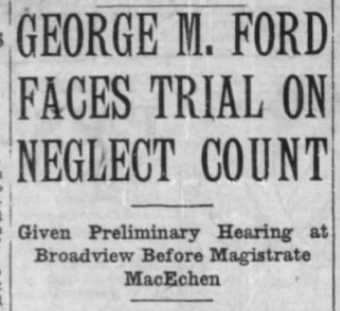
It was May 14, 1923 and George Ford was in trouble. He was at his preliminary hearing in Broadview, Saskatchewan on a charge of manslaughter, arising from his suspected neglect of a minor in his employ.

The Regina Leader-Post – May 16, 1923

John Richard Boyns had been working for almost a year at Ford’s farm, about 7 miles southeast of Broadview, when he died of double pneumonia on March 19, 1923. He was a Barnardo Boy and just 19-years-old. His time at the Ford farm was anything but easy. Witnesses testified to seeing Ford punch and kick the boy on multiple occasions and the Crown was alleging that he’d allowed Boyns to deteriorate from his illness without getting him proper medical care.

Ford had admitted to Detective Sergeant Dunnett that he’d had Boyns sleep on a cot in the cellar when there was a room in the upper part of the house that could have been used. He told Dunnett that he’d called a doctor when Boyns was sick but that he’d died before the doctor arrived. However, when Dr. Allingham testified, he told the court that in his opinion, based on the condition in which he found the deceased, Boyns had been dead some time before his arrival.

The cellar where his bed was located was twelve feet by twelve feet and six feet deep with raw earth walls. There was a fresh excavation in the northeast corner, about six feet by eight feet, with a cistern next to it. A clutter of stove pipes, bottles, and sacks lay heaped about and near the middle was a furnace constructed from an old stove covered with tin. In the southwest corner was Boyns’ cot, constructed from chicken wire nailed to two by fours. The chicken wire sagged in the middle until it almost touched the earth beneath it and the mattress was only a thin tick and not clean. One covering lay on the bed and it was dirty. On and about the bed were several articles of clothing and boots, none fit to wear. The bed was shoved close to the wall and a thin sheet was hung between it and the earth. There were a few windows in the cellar, all of which were covered in frost when the police came to investigate.

Ford was committed for trial, but on November 29, 1923 the charge was dismissed by Justice MacLean at Moosomin, who said the Crown had failed to establish that a legal responsibility to provide care rested on the accused. He was careful to tell Ford that his dismissal didn’t mean he thought Ford was a good man or that he hadn’t been cruel to Boyns, merely that the Crown had failed to prove that Boyns was incapable of calling the doctor himself.

“I am dismissing you, Ford, because by law it has not been shown that you were criminally liable. But it has come out in evidence that you were harsh with this young man. You were most harsh. You have been brutal and displayed a violent temper in your action toward him. It was a cowardly procedure.”

The Regina Leader-Post – Nov 30, 1923

The community of Broadview was not pleased with the dismissal. The story of Boyns’ ill treatment had obviously been in the news, making it across the ocean to the Old Country. On all sides there was indignation and bad feelings against the Ford family. In Broadview, the feeling was so intense that Ford and his wife were practically ostracized. Wherever they went the tragedy was recalled with curses and pointed comments.

All of this sat very heavily on the shoulders of Ford’s wife. Gertrude Ford (maiden name Drake) was under constant strain, her worry and anxiety over the hatred heaped on her from the community bringing her to the point of a nervous breakdown. She took a holiday in 1925, fleeing the district entirely for about six weeks. When she returned she was entirely restored to health, but the community’s memory was still fresh and their temper unchanged, and before long her condition again began to deteriorate. She begged her husband to sell the farm but he couldn’t get a fair price for it and they were advised to wait until selling conditions improved.

Around mid-November in 1925, one of their hired men, Norman Platts, came down with Scarlet Fever. Remembering what happened before and determined to have no more deaths in her home, Gertrude took charge of Platts and nursed him through the illness with every care.

Ford was less than pleased. He believed his wife’s first responsibility was to her children (they had a four-year-old daughter and a 20-month-old son) and that nursing the man in their home might infect the kids. He wanted to send Platts away. As Gertrude tended to Platts over the ensuing weeks he became bitter and resentful over the attention she was paying the sick man. Their marriage had grown decidedly strained since the death of Boyns and the ensuing ostracization, and they frequently got into heated arguments. Her nursing of Platts only increased the tension between them.

On December 20th, the couples’ lawyer received letters from both of them, Gertrude still desperate to sell the farm and leave and Ford complaining about having to care for Platts.

On New Year’s Eve they threw a party and seemed to be getting along better, but by the following evening, they were fighting again. Norman Platts’ brother, Ed, had come to visit him from Winnipeg. He’d stayed for the party and the following afternoon asked Ford drive him to Broadview so he could head back home. Ford had apparently believed that Ed would be taking Norman back with him when he left and when he didn’t, Ford was pissed off. He wanted Platts out of his house. The couple began fighting in earnest that evening, causing Platts and the other hired man, Herbert Kinglsey Lighton, to separate them.

The next day they began fighting again about Norman’s health and whether or not he was well enough to leave. Knowing the fight was about him, Platts told them he’d go and started packing his things. When he couldn’t find his boots, he went out to the barn to find Lighton and ask if he’d seen them. They chatted for a few minutes, Platts helping with a few chores, when they heard a dull noise at the house. As they let the barn, they heard two gunshots in succession.

Worried Ford might be shooting at them, they detoured and approached from the bush. As Platts got to the north side of the granary near the house, he saw Ford, lying on the ground dead, a shot gun laying by his feet. The left side of his face was partly blown off.

“There is one of them gone,” Platts told Lighton.

When they entered the house, they found the couple’s little girl, crying. Lighton picked her up and started comforting her. Platts went through the kitchen towards the living room and found Gertrude lying in a pool of blood, dead. She’d been shot in the back of the head with the shotgun while writing a letter. The baby boy was sitting on the floor, thankfully unharmed physically, but unfortunately had witnessed the horrific murder of his mother.

The Saskatoon Star-Phoenix – Jan 4, 1926

At the inquest into her death, it was revealed that their lawyer, F. B. Bagshaw, had received another letter from Gertrude on December 31st, detailing how her husband was driving her to another nervous breakdown. She described him watching her “as a cat watches a mouse”. She wrote that if she continued to live with him she’d go mad. “I absolutely must get away from him.” She asked him about getting a separation, telling him she wanted custody of their children.

The letter had come too late to save her.

Gertrude was buried in the Broadview Cemetery on January 7, 1926, in a different area than her husband. At least in death, she was given the separation she so desperately wanted.

As for the children? They stayed with a neighbour for a short while before being taken to Babies’ Welfare in Regina.

And that is the story of the neglectful death of John Richard Boyns and the murder of Gertrude Drake Ford.

The Regina Leader-Post – Jan 5, 1926

Thank you for reading! If you enjoyed this post, please subscribe and share it with your friends.

Information for this post came from the following editions of the Regina Leader-Post and the Saskatoon Star-Phoenix: May 16, 1923, Nov 30, 1923, Jan 4, 1926, Jan 5, 1926, Jan 7, 1926, Jan 8, 1926

If you’d like to read more true crime stories from historical Saskatchewan, give these a try:

The Attempted Murders of C. D. Bennison and Leonard Warren

The Murder of Arnold Gart

The Murder of Sarah Mulvihill

The Attempted Murders of C. D. Bennison and Leonard Warren

It was about 10:30 p.m. on July 15, 1913, and C. D. Bennison, owner of the Silver Moon Ranch just south of Manor, Saskatchewan, was putting his team of horses in the stable for the night. Out of nowhere, he was attacked by his hired hand, Lloyd Atz, who struck him repeatedly with a whiffletree, beating him to the ground. (A whiffletree is defined as “the pivoted swinging bar to which the traces of a harness are fastened and by which a vehicle or implement is drawn.”)

Bennison managed to struggle to his feet and staggered towards the house, but when he was within ten yards, Atz returned, beating him once again and leaving him for dead. But Bennison wasn’t dead. Once again, he struggled onward and made it to the house where he was taken in by his wife and Miss Wolfe, the hired help.

The women yelled for help, attracting the attention of John Procknow and his sisters, who were driving past. They went to the house and Procknow immediately barred the door. Atz returned to the house, trying to gain entry, but was unsuccessful, leaving soon after.

At this point, Miss Wolfe remembered that the other hired hand, Leonard Warren (also spelled Warne), was still outside somewhere. Miss Wolfe went out into the dark, looking for Warren, and finally found him near a straw stack, unconscious and with terrible head wounds. Alone in the dark, and despite the fact that he was one hundred and eighty pounds, she managed to carry him to the house sixty yards away.

Atz didn’t return that night and when Warren was recovered enough to speak, he told them he’d been viciously attacked by Atz, who battered him with the butt of a rifle. The rifle was found by the Royal North West Mounted Police when they came to investigate, the butt broken in two pieces and the barrel covered in blood.

The Regina Leader-Post – July 17, 1913

The police started scouring the country for Atz, and at one point it was rumored he’d escaped into the States. The police believed the attacks had been premeditated, because Atz had gone after Bennison while Warren was still in the field, rounding up the cattle, when they would be separated and more vulnerable.

Atz was found and taken into custody near Wauchope, Saskatchewan on July 21, 1913. He was a young man, only twenty-six, described as broad shouldered with light wavy hair, standing 5’8″ tall. He was taken to jail in Arcola to await his preliminary hearing, but while exercising in the corridor of the court house at Arcola he tried to overpower the guards and escape. He was taken to the Regina jail instead, where he would stay until his preliminary on July 28, 1913.

The Saskatoon Daily Star – July 24, 1913

He was committed to stand trial on two charges of attempted murder. His first trial, for the assault on Bennison, opened on December 17, 1913 before Justice Elwood. Atz refused counsel and conducted his own defense. He was described by newspapers as displaying “more than average intelligence.”

Dr. Christie, who testified to the injuries both men received at the preliminary, detailed Bennison’s injuries. (Warren had received nine bad cuts on his head and needed to go to the hospital.)

Bennison testified, describing the attack and telling the court that on two previous occasions Atz had talked about religion in a very eccentric manner. Bennison concluded that Atz was “crazy on religion” appearing to suffer from some kind of fanaticism. At one time Atz had also told Bennison that he’d been implicated in a murder in Spokane some years ago.

Lloyd Atz’s defense was simple. He told the court that the heat of the day had affected his mind and that he had no recollection of the circumstances of the crime.

When charging the jury, the judge pointed out that the evidence did not seem to substantiate the accused’s evidence (especially with his rash attempt at escape while in custody) and the jury agreed. They found him guilty and he was sentenced to ten years at the penitentiary. Given his conviction, the crown didn’t bother to proceed with the second attempted murder charge.

And that is the story of the attempted murder of C. D. Bennison and Leonard Warren.

The Regina Leader-Post – Dec 18, 1913

If you enjoyed this post and would like to see more, please subscribe! And don’t forget to share it with friends.

Information for this post came from the following editions of the Regina Leader-Post, the Saskatoon Daily Star and the Saskatoon Star-Phoenix: July 17, 1913, July 19, 1913, July 22, 1913, July 24, 1913, July 29, 1913, Dec 18, 1913

If you’d like to read more true crime stories from historical Saskatchewan, give these a try:

The Murder of Arnold Gart

The Murder of Sarah Mulvihill

A Fire Near Tisdale: The Suspicious Deaths of William Robson and Mary Swanson