It’s fair to say that the farms in the Bjorkdale district of Saskatchewan in 1925 were pretty isolated. Which is probably why no one paid much attention to the fact that Captain Allison Day left his family in October of 1925, and failed to return. It happened sometimes. Husbands left their wives and families, looking for better opportunities elsewhere.
It wasn’t until two years later that the community began to suspect that something was amiss. In the spring of 1927, Captain Day’s wife passed away from natural causes, leaving her three sons, Robert, Alfred and Henry, and her daughter, Caroline, to carry on running the farm.
That same summer, a young district farmer named Max Sinnes worked with the boys on the farm. According to him, Henry told him a very disturbing story. He confessed that his father, Captain Day, had never left, but in fact had been murdered by his mother, and he and his brother Robert had helped her cover it up.
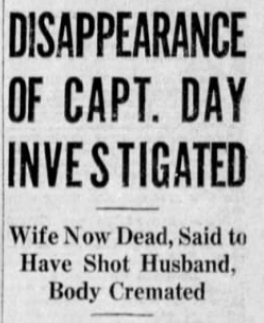
These stories made their way to the provincial police, and the case was assigned to Corporal Watson and Constable Knight of the Melfort detachment. With the information they received, they arrested the three brothers in April of 1928 for complicity in the murder of their father and the brothers were taken to the provincial jail at Prince Albert to await trial.
A preliminary hearing was launched on May 10, 1928 at Tisdale before Magistrate Lussier. Multiple witnesses were called, including Max Sinnes, who recited the story he’d heard from Henry Day. According to Sinnes, Henry told him that “Ma plugged Old Day,” going on to tell him that his mother had shot Captain Day through the head with a revolver while he was sleeping. Apparently, it had made an awful racket. His mother had then gone upstairs to get Henry and his brother Robert (Alfred was away helping a neighbor at the time) and told them she’d fixed ‘Old Day.’ They’d gotten out of bed and taken the body to a straw stack near the granary and fired the stack with him inside. He told Sinnes that the family was glad after the shooting. At the time of his arrest, Henry was only 16-years-old, while his brother Robert was 20, making them 13 and 17 at the time of the shooting.
Caroline Day, sister and youngest child in the Day family (just 14-years-old at the time of the hearing), was also called to the stand. She admitted that she knew her mother had shot their father, stating that “Mother told me she had shot Dad and had burned the body,” going on to say that her mother warned her not to tell anyone. She’d kept that promise until the day she testified. She told the court that she’d seen her dad on the evening of October 22, 1925, and the next morning her mother told her that she’d killed him.
Captain Allison Day had moved to the Bjorkdale district from Macoun, SK in the spring of 1919. His wife was in the hospital at the time, but followed a few months later. He had a reputation of being a first class workman and had been held in high repute in the Imperial army, having served in the Boer War and worked as a recruiting officer. According to his neighbors, he had a distinct military bearing at all times and was described as a good talker and a “jolly companion to meet.”
But Captain Day had a dark side. According to his children, he treated them all brutally, but especially their mother. Caroline told the court that her father “treated Mother mean and pounded her an awful lot.” He’d split her forehead once in 1923, and according to Caroline and her brothers, was persistently cruel, saying that their mother lived a life of misery.

Edward Lilley, a neighboring farmer, saw Captain Day frequently and testified that three weeks after his disappearance, he’d asked Mrs. Day what happened to her husband. She said she hadn’t heard from him. He confirmed that he’d seen Day hit his wife more than once. On one occasion, he’d seen him throw her out of the stable and throw the milking stool after her.
Corporal Watson also took the stand, to detail the arrest and the confession that Henry and Robert had given the police. Apparently, Robert and Henry had talked it over together on the way to the station and decided to tell the police everything.
According to Henry, it had happened much the way that Max Sinnes described it. His mother had awakened him and Robert after the shooting and they’d come downstairs to help her move the body. Their father was in bed, his face covered in blood, with blood on the sheets and the floor. They cleaned up and carried the body from the bed to a wheelbarrow Robert brought to the door. They’d taken the body and the bloody bed clothes to a straw stack near the granary. They’d had an awful time loading and transporting the body, as it kept falling off the wheelbarrow. Eventually they made it to the stack, and they’d shoved the body as high as possible on the straw stack before Robert set it on fire. Their bad luck continued, as the body would not burn. Robert eventually took a pitch fork and pushed the body higher on the straw stack.
As they were waiting and watching, a car was seen making its way to the house. Mrs. Day, Robert and Henry ran from the stack back to the house. It was W. L. Hayes, another farmer of the district, bringing Alfred home. He asked for Captain Day and Mrs. Day told him he’d gone away for a few days. When he left, the boys returned to the fire to keep watch and see that the body burned. However, when the fire went out, they noticed a number of bones in the ashes. Robert took them to the house in a pail and his mother burned them in the heater. According to Henry, the family had all known that their mother was going to kill Day, on account of Caroline. This reasoning was never elaborated on, so it’s unclear if they were trying to protect the youngest from the abuse, or if there was something even darker going on.
In either the fall of 1925, or the spring of 1926, Mrs. Day had sold the Colt .45 automatic revolver she’d murdered her husband with to Frank McIntyre of Star City, SK. The family kept the secret until their mother passed away, when it seemed Henry and possibly Robert, began to let the details slip.
At the end of the preliminary hearing on May 10, 1928, Magistrate Lussier dismissed the charges of conspiring to commit murder against Henry, Robert and Alfred. Henry Day was, however, committed to stand trial, charged with being an accessory. Lussier stated that Robert would be sent to receive medical attention as a “mental incompetent.” (This was something hinted at in previous articles as well. It’s possible Robert had brain injuries from the abuse Captain Day allegedly heaped on his family while growing up, or possibly he was born with disabilities from abuse to his mother while pregnant, but we’ll never know.)
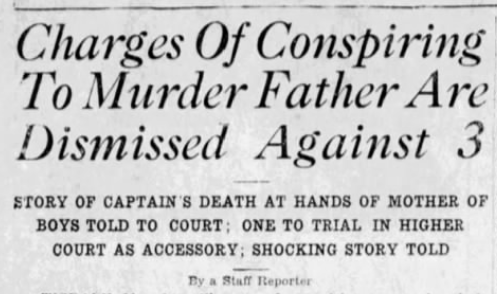
Henry Day was taken back to the Prince Albert jail to await his trial, but was released on December 19, 1928, when the prosecutor made his recommendations to the department of the attorney general that no further action be taken against the accused.
And that is the story of the mysterious disappearance of Captain Allison Day.
Information for this post came from the following issues of the Regina Leader-Post, the Saskatoon Star-Phoenix, and the Saskatoon Daily Star: April 27, 1928, May 9, 1928, May 10, 1928, May 11, 1928, May 12, 1928, Dec 27, 1928
 Melanie Cole