Content Warning: the following story includes the murder of children. If reading this will distress you or put your mental health at risk, please don’t continue.
Fenwood, Saskatchewan
On the morning of Tuesday, August 30, 1955, Nellie Petlock was worried. Her husband, John Petlock, was missing. He’d gone to his quarter section of land on his mother’s farm to do some stooking the previous afternoon at about 3:00 p.m. and hadn’t returned.
She and a neighbor walked to the family homestead where her mother-in-law, Mary Petlock, lived with her brother-in-law, Mike, and his family to see if John had spent the night, but when they arrived, they found all the doors to the home locked and the blinds drawn. Alarmed, she returned to Fenwood and called the RCMP at Melville, telling them that her husband was missing.
Sergeant Minor was in charge of the Melville detachment. He received the call and drove to Fenwood at about 2:30 p.m. He went straight to the farm of Mary Petlock and found it deserted, as Nellie had described. The cows in the barnyard had not been milked and the house was locked with the blinds drawn. Returning to Fenwood, he called his detachment for two more officers and arranged for a police dog to be brought to the scene. He made some inquiries as to the whereabouts of the family, then drove to the farm of Ednot Petlock, John’s brother, to see if any of the family were there visiting. No such luck.
Sgt. Minor returned to the Petlock farm and found Constables D. R. Murray and D. Johnston already there waiting for him. When they’d arrived and started looking around, the family dog became agitated and together with the police dog had led the officers to the garden where they’d made a gruesome discovery.
They took Sgt. Minor to the garden plot north and east of the house where the bodies of two women had been found, loosely covered with potato tops. The first was that of a young woman, laying on her side with her knees drawn up. There was blood on her face and a bullet hole surrounded by powder burns under her left armpit. It was Angeline Petlock, Mike’s wife. About 10 yards away and lying in a similar position, was the body of Mary Petlock. Two bullet holes were visible.

There were no signs of struggle in the garden, but nearby, lying on a bag of potatoes, they found a small girl’s coat, and lying in the earth next to it was a doll. The women had evidently been digging up potatoes when shot, their hands were encrusted with dirt and there was a half-filled pail nearby.
Leaving the constables on guard, Sgt. Minor returned to Fenwood and notified his superiors, then took Lloyd Taylor, a garage operator, back with him to the farm to identify the bodies.
When he returned, they forced open a kitchen window with a steel bar and Sgt. Minor entered and unlocked the kitchen door on the north side of the house. The body of Mike Petlock was lying face down on the kitchen floor in a pool of blood. His cap and lunch pail were beside the body, which was sprawled with one foot hooked on top of a kitchen chair. The hip pockets of his trousers had been turned out and a wallet containing only his license and a few papers lay beside him.
A chair lay on its side between the door and the window. It had a distinct heel print on it, as well as the ground out butt of a hand rolled cigarette still clinging to the seat. Beneath the table, they found two expended cartridge cases that were .22 caliber. There were no signs of struggle in the kitchen and no blood except for the stream that ran from Mike’s body.
Leaving the kitchen, Sgt. Minor entered a bedroom on the ground floor, where he found the body of tiny, blonde Michaleen, less than a year old. Her body lay in a blood soaked crib, covered with a sheet, one small hand protruding from beneath.
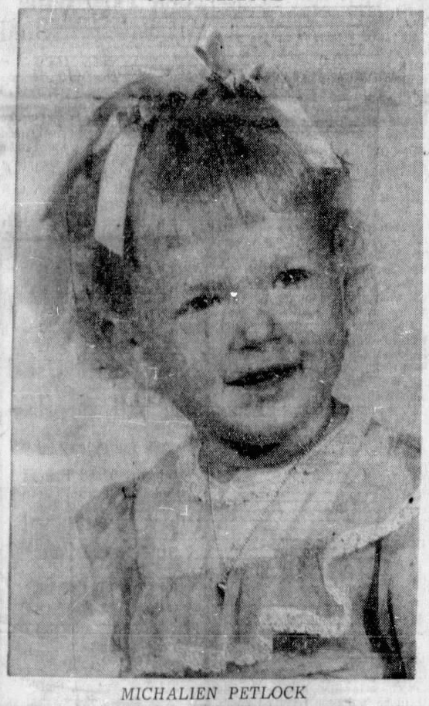
The body of three-year-old Diane was found on the bed, lying beneath a feather tick. There was very little blood on her body.
As they continued their search of the house, they found that in the rooms belonging to Mary, clothing had been pulled from the drawers and closets and littered the rooms so that according to Sgt. Minor, “it was impossible to walk without stepping on it.” They found a blood stained man’s shirt in one of the rooms and a syrup pail, later revealed to be the hiding place for Mary’s life savings. It was empty.

By midnight that night, there were 11 police officers on the scene and still, John Petlock was nowhere to be found. The following day, the RCMP used an airplane from Regina to search the countryside, but there was no sign of him.
A .22 caliber rifle believed to be the murder weapon was found by a young man named Albert Daniels and his sister, Mrs. Eva Bruce, in a roadside ditch on the No. 10 highway near Balcarres on August 30th. It was later tested and markings made by the rifle on expended cartridge cases matched those found on cartridge cases from the scene of the murders.
The bodies of the slain Petlock family remained on the farm until the afternoon of August 31st, but earlier in the day, police allowed relatives, a few neighbors and reporters to move freely about the barnyard, although they did keep them out of the garden and the house. However, one could easily see the pattern on the print dresses of the two female victims from the front steps of the house, where the bodies still lay by the sacks of potatoes they’d been filling. Two neighborhood women became hysterical when they strolled into the farmyard and spotted the women’s bodies, the chickens scratching in the dirt just 30 feet away.

But where was John Petlock? His absence was immediately suspicious, although it was still possible he was a yet undiscovered sixth victim. Police sent his description out to detachments across the province and at the borders, as well as to the newspapers. He was described as being 36-years-old, five foot five inches tall, 140lbs, with fair hair, a slim build, glasses and protruding front teeth. He was last seen wearing blue jeans, a grey shirt and a beige peak cap. They believed he might be driving a 1953, metallic green Meteor. Neighbors described him as a soft spoken, unassuming type of man.
All over the news were stories of possible sightings. A variety shop clerk in Regina was certain John Petlock had come into the store at around 12:30 p.m. on August 30th, as the fellow had been in a rush and quickly purchased a change of clothes. Many men answering Petlock’s description were picked up by police before being cleared, and one Regina man was reportedly checked three times. The police also had officers on the lookout in Vancouver and Winnipeg, where Petlock had relatives and knew his way around. Throughout, police told the public that John was just wanted for questioning, that no warrant had been issued for his arrest.

The metallic green Meteor belonging to Mike that police thought John might be driving was found parked on a Regina street on the morning of August 31st, after several residents noticed the car had been parked since at least the previous day and called it in.
They were able to confirm that John was alive when a cab driver recognized a picture of Petlock from the newspaper as being a fare he drove from Moose Jaw to Saskatoon on the evening of August 29th.

John Petlock was eventually caught on September 5th at a downtown rooming house in Edmonton, where he gave up without a struggle. His landlady, Mrs. A. Coughlin, became suspicious when he rarely left his room and made it difficult for her to get a good look at him. Paired with his lack of baggage, she decided to call the RCMP and notify them that she believed her roomer was the wanted man.
He was arrested leaving the rooming house later that day. When asked if he was John Petlock, he readily admitted he was. Corporal W. M. Peterson of the Criminal Investigation Branch at Edmonton interviewed Petlock in his office and took a statement from him. Sergeant F. B. Weekes, also of the CIB, made the journey to get Petlock. The prisoner was taken by air to Saskatoon and then on to Yorkton, where he appeared before the magistrate to be charged, and then was lodged in a cell at the Yorkton courthouse until he could be taken to the Regina jail to await his preliminary hearing.
The Petlocks
According to the surviving siblings of John Petlock, things in the family had been okay until the death of their father, Harry Petlock, on February 3, 1955. Harry had been a thrifty man who didn’t trust banks and kept his savings at home, a practice their mother continued after his death, keeping the couple’s life savings in a syrup pail, an amount that ended up being close to $12,000. The couple had many children, two daughters, Mrs. Katie Shurko and Mrs. Anne Skovmose, and five sons, Ednot, John, Mike, Walter (who lived in Winnipeg) and Peter (who lived in Vancouver).
John had been invited by their father to come live and work on the family farm in the fall of 1952, after 10 years of working on farms and in lumber camps in eastern and western Canada. This was apparently after Harry had an argument with Mike, who’d been living on the farm with his own family, which caused him to take his family and leave. John did as requested and moved home. He worked the home farm, bought some cattle with his savings and also farmed a quarter section given to him by his father. In November of 1954, John married Nellie, who moved in with them on the farm.
After Harry’s death, the family squabbles began. According to John’s sister, Katie, John and their mother began to quarrel, “always after Mike and Angeline had been there.” She testified that “John and Mike could not get along.”
In May of 1955, John and his wife moved to a home of their own in Fenwood, and by June of 1955, Mike and his family had returned to live with the elderly widow, who was now 70. When John left, he took his cattle, a tractor, two pigs, two horses, some harrows, a plow and a drill. His mother started a law suit soon after to get possession of some of those articles.
Things were not peaceful between Mary Petlock and Mike either. The elderly woman complained of his spending too much time away from the farm and of costly trips to Melville. On one occasion, during a family gathering, Mike and his mother had struck at one another when she tried to get him to leave the room. On his sister, Katie’s arrival, he’d greeted her with “have you come for more property?”
It appeared the death of Harry Petlock had caused some bad blood over inheritance. Ednot Petlock blamed the family quarrels on John’s request for his mother’s farm, or instead, a gift of $5000, both of which were refused. According to Ednot, John alleged that Ednot and Mike had received more than he had from their father’s estate.
The Trial of John Petlock
Following the finish of a Coroner’s Inquest, which had been started after the discovery of the bodies and then paused while the police concluded their investigation and John Petlock was arrested, a preliminary hearing was held at the Melville Legion Hall. John Petlock was defended by Emmett M. Hall, QC, of Saskatoon and P. J. Dielschneider of Melville. Representing the crown was H. E. Ross, QC.

During the preliminary, some of the details of John’s flight from the Petlock farm were revealed when three cab drivers were called to testify. James Hazlet had been engaged by John to drive him from Regina to Moose Jaw on the evening of Monday, August 29th, telling him he needed to go there for work.
That same evening, James Keay was approached by John in Moose Jaw, asking for a ride to Saskatoon. Keay testified that he calculated the distance and told him the price for such a trip and Petlock didn’t even blink. He told the cabbie he wanted to go to Saskatoon immediately because his brother had died. Petlock had changed clothes while they were driving, telling the driver about his brother dying and his anxiety to get to Saskatoon. He’d told him he’d once worked logging camps around Vancouver but now worked on farms and had been combining around Belle Plain when he’d heard about his brother and gone directly to Moose Jaw. That was why he was so dirty, he explained, and needed to change. They’d arrived in Saskatoon at 2:00 a.m. on August 30th. Keay had taken Petlock to the CNR depot, but it was closed. Another cabbie had suggested that Petlock try the bus depot, which was when Keay parted ways with Petlock.
Apparently having no luck at the bus depot, Petlock rented a room from Alvina Peters at 528 2nd Ave. North in Saskatoon, telling her his name was Art Redcliffe and that he’d just had an appendix operation and needed to rest up for two weeks. He only stayed the night however, and the next day engaged R. J. Hagen to drive him to North Battleford. Hagen testified that while they were driving, Petlock asked him to turn off the radio. A soap opera was playing and he told him he didn’t like the screaming women in them. At this, Prosecutor Ross replied, “you can’t blame him for that.”
This drew a broad smile from the otherwise stoic Petlock, as he slapped his leg and stamped his foot on the floor.
John Petlock was committed to stand trial and sent to the Prince Albert common jail to await his trial.

The trial began on March 6, 1954 at Melville before Justice Thomson. Petlock pled not guilty. The Crown had chosen to only charge Petlock with the murder of his brother, Mike; it seems they felt that was where they had the strongest evidence. It’s not clear if they planned to charge him with the rest of the murders after, or had never planned on doing so.
The Crown’s case was straightforward. John Petlock had been called to his lawyer’s office the morning of the murders to discuss a new turn in the legal action between him and his mother. She was demanding the return of a granary in John’s possession and stated that if it was not returned, she would sue. John had gone to the lawyer’s office at 12:45, they’d discussed actions to be taken and he’d left shortly after 1:00 p.m. At about 3:00 p.m. he had gone to his mother’s farm, allegedly to stook grain.
William Romaniuk, the section foreman at Cokmer near Fenwood where Mike was employed as a section hand, testified that Mike had left for home as usual at 5:00 p.m. that day and had failed to return to work the following day. William had assumed Mike had taken the day off to do some stooking on his farm.
According to Dr. W. H. Houston, the pathologist at Regina General Hospital who had done the autopsies, Mary had been shot three times in the right chest and once in the left, as well as in her right hand. Angeline had died of hemorrhage and rupture of a heart vessel caused by two wounds, one in the left chest and one in the left shoulder, but had been shot in the back as well. Diane had been shot in the left chest and right back and Michaleen two times in the chest and once in the back. Mike, he believed, was the last to die. He had four wounds. One in the right eyebrow, one above his right ear, one in the left chest and one in the right hand. Dr. Houston believed the shot in his right eyebrow had been fired first, followed by the one above his right ear and that death would have been immediate, although had the chest wound been the only wound, it would also have proved fatal.
The rifle, tested and believed to be the murder weapon, was identified by two cousins as one they’d loaned to John Petlock in mid-June to “scare dogs away from his chickens.”
Police believed that John had gone to the farm and killed the two women first, then three-year-old Diane. After covering up the women, he’d carried the little girl’s body into the house and placed it in the bed, then shot 11-month-old Michaleen in her crib and covered her up as well. He’d gone to the kitchen and smoked a cigarette, waiting for Mike to return home. When he heard the car pull up, he’d stood on the chair (hence the heel print) and shot Mike as he came in through the door. He’d then ransacked the house, taken his mother’s money (which had been found on his person when arrested) and driven to Regina. The killings were cold and methodical, with several of the gunshot wounds fired at close range.
A neighbor, Alfred Matishuk, testified that he’d been doing some stooking for Mike Petlock on August 29th, the day of the shootings, about 600 yards from the house. At about 6:45 p.m. he’d noticed Mike’s car parked in its customary place near the rear door of the house and then a few minutes later had watched it drive out of sight southward on the No. 15 highway.
Walter Petlock and his wife, Gladys, also testified about visiting John at the Regina jail after his arrest. Gladys told the court that John said, “if I could have controlled myself after the first shot, I would have been alright.” Walter corroborated this, saying he told his brother to stop because he didn’t want to hear any more of what happened.
After a seemingly endless stream of witnesses and evidence, including the chair and the blood soaked clothes of the victims, the prosecution finally finished its case and it was time for the defense.
The strategy of defense lawyer, Emmett Hall, was quite brilliant. According to Petlock’s own statement to the police in Edmonton, he’d shot his brother in self defense. As for the rest of the family? He’d only learned of their deaths from the newspapers while he was on the run. He had no idea they’d been killed.
John Petlock took the stand in his own defense and told the following story. On the afternoon of the murders, he’d been stooking and heard shooting, so he went to the house to investigate.
“As I neared the corner of the house, Mike came out of the house carrying a rifle. I asked him what all the shooting was going on. He jumped and looked around and shouted at me, ‘so you have come for some medicine too.’ ‘What kind of medicine?’ I asked and he said, ‘I am fed up with this already.'”
Then, according to Petlock, “he swung and pointed the gun at me and was going to shoot me so I jumped and grabbed the rifle.”
“So then he shot at me, but it missed me and went under my right arm.”
Petlock went on to describe a vicious battle that took the struggling men across the farmyard, until Mike tripped over a pile of onions and fell, dragging Petlock down with him. “I got up and threw the gun away.”
Mike then chased him around and around a chicken coop and held out his hands shouting, “you will die in these hands today.” Apparently, Mike tried to get the rifle again, so Petlock jumped on his back.
“I jumped on his back and pulled the rifle out behind, over his shoulder. He came at me like a mad bull and grabbed the rifle by the barrel. I tripped and the shot went off. It hit him pretty high.”
When asked if Mike then fell down, Petlock said no. “He came at me again, clawing and swinging his hands and hollering. All I could make out was ‘shoot some more, shoot some more.'”
“Oh God, I was completely out of control, my head was like fire so I fired two more into him. The next thing I saw he was lying dead in front of me.”

Next, Petlock admitted he dragged the body into the kitchen. “I took his feet and threw them over and he landed on his stomach.” He tried to clean some blood off his shirt with a cloth and wiped spots from the concrete step outside the kitchen. He told the court he wandered through the house and noticed it was in a chaotic condition, but didn’t see the children.
He went outside, found a suitcase in Mike’s car filled with clothing and a bundle of money. The keys weren’t in it, so he went back and searched Mike’s body for the keys, then left.
Petlock went on to speak about the family arguments and his treatment by other members of the family. He stated that the arguments he had with his mother after his father’s death were mostly over his wife. “Mother did not agree with her work.” He alleged that his brothers, Mike and Ednot, had contributed to the trouble by “telling tales and lies to mother.”
He denied asking his mother for the farm or $5000, saying he’d instead offered to buy the home farm for $5000 when it was suggested that, because of her age, Mrs. Petlock should leave the farm and reside with members of the family.
Under cross examination, Petlock said he wasn’t interested in the money he’d taken with him and didn’t even know how much there was until it was counted by the police when he was arrested. When shown pictures of his brother’s body sprawled on the kitchen floor, Petlock stated that the body wasn’t the way he left it. And when asked if he thought the non-appearance of the rest of the family was odd, Petlock replied that he thought they were likely “at a funeral or in town.”
He did not, however, deny that the heel print on the chair was his, stating that he stood on it to pin up a torn window blind.
At this Ross asked him, “if you stood on the chair to fire the rifle as Mike entered, you would have an advantage, would you not?” to which Petlock replied, “yes, if you want to put it like that.”
To try and back up Petlock’s version of events, Dielschneider had taken some samples of what looked like possible blood from the concrete step and sent it in for testing. Those tests showed traces of human blood, but it could not be determined how long the blood might have been on the steps.
Sgt. Minor and Constables K. Murray and M. B. Toews had conducted tests to establish the audibility of the report of a .22 rifle fired with a strong wind blowing from the northwest on the Petlock farm (as wind charts from the Yorkton weather office showed for the day of the crime). They concluded that shots could not be heard at a distance greater than one tenth of a mile. However, these wind charts from the Yorkton weather office were not allowed to be admitted as evidence by Ross, as Justice Thomson ruled that it was not established that conditions would have been the same at Yorkton and Fenwood.
In his final two hour and forty minute address to the jury, Hall told them to look at the evidence and decide if Mike was killed in the kitchen or outside. He stated that the police had formed their theory that Mike was killed in the kitchen, and closed their minds to anything else. They’d failed to search the outside area properly and despite an “inch-by-inch” search of the kitchen had failed to “turn up a single thing.” According to Hall, the bullet that entered Mike’s eyebrow had found its exit through the ear. “If Mike was shot down in the kitchen as the crown contends, then where is that bullet?”
He pointed to a bunched up mat and clothing of the victim bunched beneath his arms, as shown by police photos. That was proof, he said, that Mike was not shot in the kitchen. They indicated he was dragged.
There were three cartridge cases found in the house, two in the kitchen and one beneath the crib. The baby was shot three times, could not all three cartridge cases have been from that? He also pointed out that no dirt was found in the kitchen, even though his client was supposedly in the garden, where the soil had adhered to the fingers and shoes of the victims. There was no dirt on the floor of the Petlock car either.
In Ross’s address for the Crown, he pointed out that John Petlock had a double motive for the crime: greed and revenge, stating that Petlock not only shot his brother, but the rest of the family. The defense had inferred that Mike had shot the rest of the family, but Mike had no reason for shooting his own children and wife. All the evidence pointed to Mike coming home from work and being killed in his tracks in the kitchen at about 5:30 p.m.
“I submit that he was killed just as he got into the house and not in the yard as accused would like us to believe from his unbelievable and sketchy story. I also submit that the accused, with his own gun, killed the people in the garden, and because Dianne was a bright little girl and could have been a damning witness, she was shot and carried in and placed on her bed.”
He told them to consider his actions after the crime. After the killing he fled with his brother’s car and his mother’s money, used a variety of names and told many different stories. He told the jury that on the morning of the crime there was a break in the serious litigation going on between the accused and his mother and it proved too much for him.
It was time for the jury to decide. Had John Petlock gone to his mother’s farm with murderous intent and slaughtered the entire family before laying in wait for his brother? Or had he stumbled across a family massacre only to get in a fight with the killer and come out ahead, grab the stolen money and run? Would Mike have had time to come home, murder his family, cover their bodies and then get into the vicious fight described by John if he’d left work at 5:00 p.m. and his estimated time of death was 5:30? And if he’d come out of the house brandishing the rifle, how did he come to have the rifle, if it was the one John had borrowed from their cousins in June? What of the lunch pail and cap next to his body? Had John grabbed them and placed them there?
The case went to the jury at noon on March 16, 1956, and just four short hours later, they reached a decision. They found Petlock not guilty of murder, but guilty of manslaughter. They believed his story, but decided, possibly because of the multitude of shots, that he’d gone overboard.
John was sentenced to 17.5 years of hard labor at the Prince Albert penitentiary. In passing sentence, Justice Thomson told Petlock he was taking into consideration the 6 months Petlock spent in custody, the fact that he had no previous record and the background of family strife that preluded the slaying. He assured Petlock that the sentence could be reduced by good behavior.
As he left the courtroom, John Petlock was heard to say, “phew.”
Petlock’s defense attorneys appealed the sentence, saying it was too harsh, but it was upheld by the appeals court.
He was released from the penitentiary in January, 1967, after serving 11 years of his sentence. According to “myheritage.com” and “ancestors.familysearch.org”, he died on September 14, 1967 at 48 years old. He was 36 at the time of the killings.


Thank you for reading! If you enjoyed this story, please feel free to subscribe and share it with friends!
Information for this post came from the following editions of the Regina Leader-Post and Saskatoon Star-Phoenix: Aug 31, 1955, Sep 1, 1955, Sep 2, 1955, Sep 3, 1955, Sep 6, 1955, Sep 7, 1955, Sep 8, 1955, Sep 14, 1955, Sep 22, 1955, Sep 30, 1955, Oct 4, 1955, Oct 6, 1955, Oct 7, 1955, Oct 8, 1955, Oct 11, 1955, March 6, 1956, March 7, 1956, March 8, 1956, March 9, 1956, March 10, 1956, March 12, 1956, March 13, 1956, March 14, 1956, March 15, 1956, March 16, 1956, March 17, 1956, April 11, 1956, Sep 2, 1956, Dec 11, 1956, Aug 16, 1967
If you’d like to read more historic murder cases from Saskatchewan, give these a try:
Murder in Spiritwood: The Mysterious Death of Ovilla Laventure
 Melanie Cole
One thought on “The Petlock Murders”
Comments are closed.