
*Content Warning: This case is about the murder of a young girl. If this subject will be upsetting to you, please protect your mental health and skip this post.
***
Let’s begin.
On the afternoon of June 28, 1928, 10-year-old Anna Goff was on her way home from the Uxbridge School in the Eastwood district, about 30 miles southwest of Shaunavon, Saskatchewan.
She rode in a buggy with her teacher, Mrs. Toriund, and several other students for part of the way. When they reached a slough, she and some of the other children got out to walk around, as the load was too much for the horse. Being less than a mile from home, she and a smaller boy named Tommy Fairburn decided to walk the rest of the way.
She was walking slower than Tommy, dawdling, and eventually he outdistanced her and she was walking alone. The kids still in the buggy noticed a man riding horseback in the pasture next to where she was walking, recognizing the horse as “Kaiser”, a well known race horse in the district. They also recognized the rider as William Hugh Megill, a 27-year-old laborer.
As they continued on their way, one of the boys noticed Megill leaning over the pasture fence and talking with Anna.
When Anna didn’t arrive home soon after the other children, her foster mother, Mrs. W.A. Brooks, started to worry. Anna was an orphan, a ward of the Child Welfare Bureau, who’d been placed in the care of Mr. and Mrs. Brooks, who had plans to adopt her. Mrs. Brooks notified her husband of her concern and Mr. Brooks immediately went out to search for Anna. While he was looking, he noticed a man hurry from the barn to the shack on the isolated farm of Roy Kroetch. He drove over in his wagon, but couldn’t see anyone. He shouted, but received no answer. Certain he’d seen someone go into the shack, he forced the door and found Megill inside.
When Brooks asked Megill about Anna, he said she’d ridden away on horseback with a man. Then he left in a hurry on his horse, although not before Brooks relieved him of a .32 rifle.
Several neighbours joined in the the search for Anna and an hour or so later, a man referred to as W. Maurice walked over to an old flax straw stack. He noticed the straw had been disturbed and lifted it up, only to find the mutilated body of Anna Goff, her throat cut so deep her neck was practically severed.
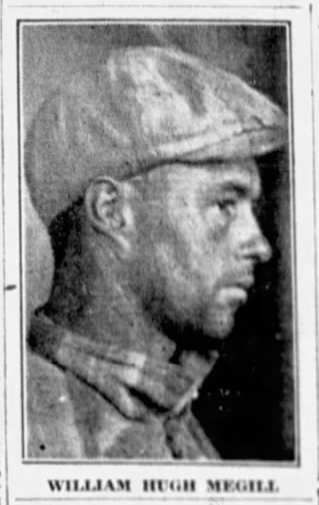
The searchers were obviously horrified. They’d been expecting to find the girl alive and well. RCMP rushed to the scene and sent off telegraphs and telephone calls to other districts to be on the lookout for William Megill.
Megill was traced to the town of Frontier, where it was discovered he’d gone for a haircut and a shave, telling the barber to “forget all about me when I leave this shop.” He’d lined up a ride to the border as well, but was found and taken into custody before he could slip away.
He was charged with the murder of Anna Goff and kept in Regina jail until his trial opened in Shaunavon on October 30, 1928 before Justice Bigelow. William M. Rose, K.C., of Moose Jaw and H. M. Underhill, the crown attorney for the district, worked together to prosecute the case. M. A. McPherson of Regina was contracted for the defense.

The prosecution’s case was simple. Megill had issued an invitation to Anna to go for a ride on his horse, which she had accepted. She’d then been ‘outraged’ and murdered by Megill.
The defense, surprisingly, didn’t deny that Megill had done it. Instead, they claimed that Megill was not mentally responsible, because of a head injury he’d received at 13. His mother travelled from Markham, Ontario, to testify to this, telling the court that he’d been wounded in the head by a gunshot. A bullet had grazed his brain on the right side, and he’d been unconscious for some time. There was only one bullet hole, so it was believed pieces were still inside his head. She told the court that he’d been normal before the injury, but afterwards had complained of severe headaches and acted queerly at times, nervous, and with a vacant stare in his eyes. The defense said this injury was further exacerbated by a fight Megill had gotten into with a man named Earl Mason, during which he’d received several blows to the head, just four days before the murder.
The jury didn’t buy this defense and on November 1, 1928, they found him guilty and he was sentenced to hang on February 1, 1929.
On January 14, 1929, a new trial was ordered after Mr. McPherson appealed the verdict at the Saskatchewan Court of Appeal, on the the grounds that the judge had erred in directing the jury as to the degree of proof necessary to prove insanity and further erred in failing to distinguish between the degree of proof required to justify a verdict of not guilty on the grounds of insanity and the degree of proof needed to justify a verdict of guilty.
On April 15, 1929, the second trial began, once again at Shaunavon, this time before Justice George E. Taylor.
The testimony was mostly the same, with the addition of a man named Aristide Maurice, who testified that he noticed a fresh clot of blood on Megill’s sock the evening of the murder. Megill had told him it was from an injury he’d received in his fight with Mason four days prior.
In both trials, a statement William Megill had given police was entered into evidence, in which Megill told police that he’d left the home of his girlfriend of two years, Miss Louise Kendrick, at about 2:00 p.m. on June 28th after drinking several glasses of her wine (unknown to her). He’d taken the Kaiser horse and ridden to Roy Kroetch’s place with the intention of staying and milking Kroetch’s cows for him when he got back from the Eastend stampede. His head was aching and he was worrying about his fight with Mason and started drinking lemon extract. He stayed for a while and remembered picking up a butcher knife and either putting it in his pocket or the inside of his jacket. He remembered getting on his horse and said he had a faint recollection of being in the pasture. He didn’t remember the murder, only vague impressions of Anna being on the horse, of taking her near the flax straw stack. And that was it.
Dr. A. Deserre and Dr. J. B. Storey testified that death was practically instantaneous for Anna. Dr. Frances McGill testified to finding human blood on the girl’s garments, Megill’s clothing, a large butcher knife and on other articles in the Kroetch shack.
The defense displayed x-rays of Megill’s head, which showed the presence of foreign metallic substances in Megill’s skull and brain. Their doctor explained that this might cause epileptic equivalents such as loss of memory, dizziness, and nervous trouble, and would be aggravated by blows to the head.
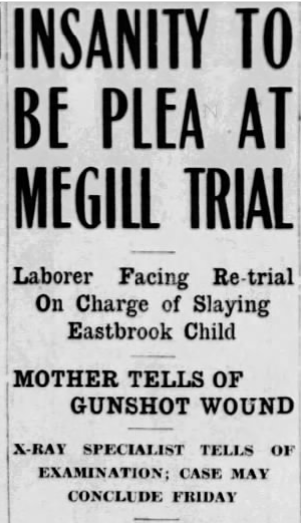
On April 19, 1929, William Hugh Megill was once again found guilty and sentenced to hang on July 26, 1929. The jury was out for just three hours.
Megill’s lawyer, Mr. McPherson, continued to fight fiercely on his behalf. He truly believed that Megill was not mentally responsible for the murder. A petition asking for Megill’s sentence to be commuted was circulated in May of 1929 and gathered about 200 signatures. But on July 17, 1929, the request for reprieve was refused and on July 26, 1929, William Megill was hanged at the Regina jail.

He left a series of letters for friends and relatives, including a long letter to the warden of the Regina jail, thanking him for his kindness. He never mentioned feeling any kind of sorrow or regret for what he’d done, nor did he take any responsibility, placing the blame firmly on his head injury.
His remains were put on an eastbound train to be taken to Markham, Ontario for internment.
And that is the story of the horrific murder of Anna Goff.

Thank you for reading! If you enjoyed this post, please subscribe and share.
Information for this post came from the following editions of the Saskatoon Star-Phoenix and the Regina Leader-Post: Oct 24, 1928, Oct 31, 1928, Nov 1, 1928, Nov 2, 1928, Jan 4, 1929, April 13, 1929, April 15, 1929, April 16, 1929, April 17, 1929, April 18, 1929, April 19, 1929, April 20, 1929, April 22, 1929, May 13, 1929, July 17, 1929, July 22, 1929, July 24, 1929, July 25, 1929, July 26, 1929, July 27, 1929
Interested in more historical true crime from Saskatchewan? Give these a try:
 Melanie Cole
3 thoughts on “The Murder of Anna Goff”
Comments are closed.