It was well into the night on November 28, 1922 that Fred Barnsley’s body was found on the south side of a coulee on his farm, seven miles southwest of Hodgeville, Saskatchewan.
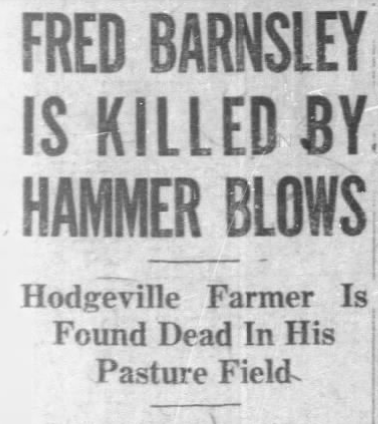
The story, as it was told to the police, went like this. On the evening of November 28th, Henry Stahmann had arrived at the Barnsley residence while the family was still eating supper. He’d waited until they were finished, and then he and Barnsley had talked for a while before deciding to walk together to visit Stahmann’s brother, Charlie. They’d set out but returned five minutes later so Fred could retrieve some money they had put aside in the house. The amount added up to $75, which he counted out in full view of Stahmann. Barnsley put the cash in his pocket and the two men left again.
His wife, Maggie, asked him at the time what he needed the money for, but he didn’t give her a satisfactory answer. About an hour later, two men showed up at the door, asking after her husband. Maggie recognized one of them as being one of Henry Stahmann’s brothers. She told them Fred and Henry had gone walking in the pasture and they left. An hour or two later, she was told by neighbours that her husband was dead.
In the meantime, Henry Stahmann told police that he and Barnsley had set off for his brother’s place as Maggie Barnsley described. As they reached the coulee, two men had rushed them, striking Barnsley in the head with a hammer and Stahmann in the back and head. Stahmann managed to get away and ran to his brother’s place. Upon hearing about the attack, Charlie went to the home of Charles Michell (sometimes spelled Michael) for help. They took Henry to their father’s place along with Charlie’s wife and children, then set out, looking for Barnsley. Several other neighbours were roused and asked to join the search, and eventually they found Barnsley as described, by the coulee. He was dead, with multiple skull fractures and lacerations on his head.
The thing was, the hammer that was found at the scene, near Barnsley’s body, was… Fred Barnsley’s. He’d loaned it to Henry Stahmann earlier that day.
The hammer was splattered with blood, but there was also the thigh bone of a steer or ox at the scene, so badly stained in Barnsley’s blood that the police believed it was most likely the murder weapon, and the hammer was perhaps spattered with blood during the attack. There were “great quantities of Barnsley’s life blood about the scene, and the clothing of both men was saturated with it.”
Indeed, the knees of Stahmann’s trousers were soaked with blood, as was the sleeve of his coat from wrist to elbow. As for his own injuries, Stahmann complained of being sore everywhere, and had a few scuffs and scrapes, but that was it.

According to Barnsley’s wife, the Thursday before the murder, Stahmann and Barnsley had discussed the selling of the Barnsley farm to Stahmann. They’d agreed on a price of $4000, $1500 of which was supposed to be paid in cash. Stahmann told Barnsley that he’d return on Saturday to close the deal, but he didn’t show. On the following Tuesday morning, the day of the murder, he’d come and asked to borrow the hammer, supposedly so he could fix a fence. Very little was said about the farm deal at the time.
Barnsley and his wife had been married in 1918 and had a young child. The couple had made plans to return to England, with tickets to set sail on December 15th. They were done trying to survive and scrape a living from the harsh prairie landscape, and were going to dispose of the farm. Barnsley was to take over a confectionary shop operated by his mother.
On November 30, 1922, police arrested Henry Stahmann at his father’s farm and took him to Swift Current. On the way, he asked to stop and see Barnsley’s widow. When he saw her, he hung his head and said, “I’m awfully sorry it happened.”
The following day, at Swift Current, he told Inspector Stewart, “I want to tell you all about it.”
He told the Inspector that on the morning of the murder, he’d gone to the home of Fred Barnsley and talked with him for about half an hour about a deal for his farm, then left for Hodgeville with Barnsley’s neighbour, Lester Wilson. He said he’d asked to borrow the hammer, but hadn’t taken it with him as he was going into town. He spent some time in Hodgeville, shopping and at the pool hall, then caught a ride back to Wilson’s with Chris Gaspers and Carl Scott. He’d walked over to Barnsley’s and waited ’til they were done supper. Barnsley told him he intended to go to Charlie Stahmann’s, so they decided to go together.
“On the way over we got to quarreling for the place and everything that was on it, and I was going to take that over, to let him sell everything on the place except the buildings, that way the cash payment would be $1500, I figured. The quarrel started over the amount of cash payment. He hit me and I hit him, I don’t know how many times. We scuffled around a while and I picked up something that was lying there and hit him several times and then went away. I never thought I had killed him until they came and told me. After I had hit him I knew that I had cut him because I could feel the blood.”
The $75 that had been on Barnsley’s person was missing and the insides of his pockets were stained with blood, as though bloodied hands had been stuck inside. But Stahmann denied all knowledge of the money or what had become of it.
On December 1st, the same day Stahmann was confessing to the murder, a reporter was interviewing his family back at Hodgeville. The family was well regarded by their neighbours, the parents considered pioneers of the district. But unlike his brothers, Henry was described as prone to idleness and “frequent debauches on alcohol concoctions.” Among the pool room regulars, he was referred to as “The Tank.”
His parents showed every bit of their despair and worry. His father, Gerhardt (sometimes seen spelled as Giarth) was described as tall, gaunt and workworn. His mother’s face described as worn and lined with worry.
One of Henry’s brothers, Joe, told the reporter, “if it’s true it will kill the old folks. I don’t know whether he did it or not, but if he did he should get what is coming to him.” He said this without any apparent malice towards his brother, going on to say, “I didn’t know Barnsley so very well, but he seemed a likeable fellow, not the sort that would have any enemies.” He admitted asking his brother if he’d done it, to which Henry had quickly replied, “no, I didn’t.”
Charlie, described as tall and muscular with a swarthy face and tousled hair, took no part in the conversation. His wife sat next to him, her eyes red from weeping as she nursed their third child. The only remark Charlie made was when he was asked if he could be photographed. “Why do you want it? They can’t do anything to me. I was home when it happened and was there all evening. When Henry came to the house my wife and I were in bed.”
Just before the preliminary hearing on December 6, 1922, Stahmann admitted to police that he’d taken the $75 off Barnsley. “After Fred was lying on the ground, I put my hand into his pocket and took out the money, which was in bills.” He said he’d first hit Barnsley with the hammer, then lost it and picked up the thigh bone.
At the hearing, he told his father where to find the money, who promptly told Inspector Stewart and the two men went and found it exactly as described, the outside $5 bill covered with blood.
Stahmann was committed to stand trial at Gravelbourg and taken to Regina jail.
On December 29, 1922, Inspector Stewart told reporters that he’d received a letter from Stahmann wishing him a Merry Christmas and inviting him to visit at his earliest convenience. It would seem Inspector Stewart was in no hurry to take him up on it, because it wasn’t until March 8, 1923 that Inspector Stewart appeared in the news again, telling reporters that he’d recently visited Stahmann and he’d confessed that his brother Charlie and Charles Michell were accomplices in the crime, although he’d told Stewart that he’d done the actual killing.
The new story went that Charles Michell had been playing poker with Barnsley the night before the murder until about 5:00 a.m. He and Charlie Stahmann had gone to Henry about a plan to rob Barnsley. They’d go to the coulee in the pasture on Barnsley’s farm and Henry would go call for Barnsley and walk with him to the hiding place. But, at the time of execution, they’d accidentally jumped on Henry, mistaking him for Barnsley. Barnsley had run away and the two Charlies had run after him and hit him with their fists, knocking him to the ground. After that, Charlie Stahmann ran away.
Both men were arrested, and on March 14, 1923, both men had a preliminary hearing. The confession by Henry Stahmann was not allowed in as evidence. When shown the confession at the hearing, Stahmann said it was not the one he’d made to police in early March. Instead, he reiterated his first confession, saying that on the night Barnsley was killed, they were walking and had been suddenly attacked by two men. In the mix up, the assailants ran away and he found himself fighting with Barnsley. He testified that Barnsley had said several times, “I’ll get you, Henry” and flourished a hammer.
“I stepped on something hard and round. I don’t know what it was but I picked it up and struck Barnsley with it. I hit him several times and finally he fell. He was struggling on the ground and making threats against me when I left him.”
He denied making any mention of his brother or Charles Michell in his statement.
Charles Michell was released, but Charlie Stahmann was committed for trial on a robbery charge and released on $12,000 bail.
The trial for Henry Stahmann opened on April 4, 1923, before Justice Bigelow at Gravelbourg. Stahmann plead not guilty, and as he didn’t have council, one was appointed for him, a Mr. Coutou (also seen spelled Cotu). The defense’s main argument was that it was not murder, but self defense.
His father testified about his son telling him where to find the money and how it was recovered in the exact spot he described. His brother, Charlie, told of Henry coming to his house in the darkness with blood smeared on his hands.

Barnsley’s widow told of the proposed sale of the farm and the events of that evening. The hammer and thigh bone were brought out, as well as the blood stained clothing. Barnsley’s injuries were described and how it was believed he most likely died almost immediately, which detracted from Stahmann’s story that Barnsley was still uttering threats when he left him. And there was the telltale lack of marks or injuries on Stahmann.
On April 5, 1923, the jury deliberated for less than 30 minutes before finding Henry Stahmann guilty. He was sentenced to hang on July 6, 1923.
His brother, Charlie Stahmann, was freed and the charges dismissed when Justice Bigelow declined to allow Henry’s alleged statement to be admitted into evidence.
On May 23, 1923, newspapers reported that Maggie Barnsley and her child had left for England, to make a home with her parents. However, on Fred Barnsley’s tombstone in the Hodgeville cemetery, there is a plaque that reads “Maggie Barnsley, his dear wife, 1885 – 1965”, so perhaps she later returned, or the newspapers got it wrong and she decided to stay. Fred Barnsley was 35-years-old.
In June of 1923, a petition by friends of Henry Stahmann was circulated and sent to the Minister of Justice, asking him to look into the sanity of Henry Stahmann, despite several doctors reporting that he was in fine health and perfectly sane at his trial.
No reprieve was granted, and on July 6, 1923, Henry Stahmann was hung at the Regina jail and buried at the Regina cemetery. He was 22-years-old.
And that is the story of the senseless murder of Fred Barnsley.

If you enjoyed this post, please subscribe and share!
Information for this post came from the following editions of the Regina Leader-Post, the Saskatoon Star-Phoenix and Saskatoon Daily Star: Nov 30, 1922, Dec 1, 1922, Dec 2, 1922, Dec 4, 1922, Dec 5, 1922, Dec 6, 1922, Dec 7, 1922, Dec 30, 1922, March 9, 1923, March 13, 1923, March 14, 1923, March 31, 1923, April 4, 1923, April 5, 1923, April 6, 1923, May 12, 1923, June 4, 1923, June 27, 1923, July 4, 1923, July 5, 1923, July 6, 1923, July 7, 1923
If you’d like to read more historical true crime from Saskatchewan, give these a try:
The Knifing of William James Brown
 Melanie Cole
3 thoughts on “The Murder of Fred Barnsley”
Comments are closed.